In keeping with the style of season two, I will present my thoughts on the Severance finale in a random and disjointed way.
I loved the conversation between iMark and oMark. Season one never fully delivered on the most fascinating part of its premise—what it means for one person to be two people. Season two did. The Marks trading home videos with each other was such a creative way to make the first innie-outie interaction happen.
I loved the emotional awareness from oDylan in his letter to iDylan. I think of iDylan as the Hurley of Severance. He sometimes speaks for the audience, and we can relate to his ability to find simple joys in a strange situation. So it hurt to see him so despondent at the end of episode nine. I also didn’t like how they made oDylan seem like such a lout for most of this season. His letter saying he’s comforted knowing his innie is down there was really sweet. But…
I think this storyline (and a few others I’ll mention in a minute) might have been the victim of rumored conflict between Severance creator Dan Erickson and writer Mark Friedman. They apparently couldn’t stand each other in season one and had to grin and bear it to get through the much delayed, heavily re-written season two. Beau Willimon (House of Cards guy) came on to fix the later half of season two and will take on a more prominent role in season three. Good. Pretty much everything after the ORTBO was a mess. Beautifully made, but a mess.
The love triangle between iDylan, oDylan and his wife might be an example of this. What was this, like six scenes in the entire season? It feels like we saw an abbreviated version of something they meant to explore more deeply. Ricken’s book project with Lumon could easily be another. That had one or two scenes at most? The only one I can remember is the one with Natalie.
Irv’s season two arc also felt stunted. Why give him a mystery phone conversation in episode one and not resolve it? That seems like a very odd string to leave dangling until season three. They also just kinda aborted his entire season after the dinner at oBurt’s house. Why go through all that—including Burt accidentally (?) revealing he worked at Lumon before being severed—then drop it for two episodes? And then not really address any of it when you put Irv on a train to somewhere Burt can’t know. I can’t help but wonder if that was initially meant to be something much different than what made it to our screens.
I loved Drummond. He was a good character and one season feels like the right amount of time for him to be part of the story.
And actually what was with having two character-centric episodes in a row? I can’t remember any show I’ve ever watched that took back-to-back detours like that. It took us out of the season’s natural momentum and actually de-emphasized iMark’s completion of Cold Harbor. Mark didn’t go to work from episodes seven through nine. That’s three installments of the show where he made zero progress on what we were told would be the greatest moment in the history of the planet Earth. You couldn’t make it less dramatic if you tried.
Ms. Huang is another character who seems like she should have been more impactful to season two’s outcome. What was the point of her really? I can come up with two possibilities. She might have been a way to help the writers work Milchick into a simmering rage (more on him shortly). Or she might have been a timely example of the way Lumon exploits children. I’m fine with either. But shouldn’t she have, like, done something tangible? In the end she mattered exactly zero to the four refiners.
Now let me vent on something I really hated about the season two finale: Milchick. My favourite storyline this season was the way they kept pushing this character closer and closer to his boiling point. Think of all the indignities he endured at the hands of Lumon: Not taking Cobel’s name off his computer, being put in charge of a child intern, a humiliating performance review, those weird paintings with massive racial undertones, being mocked by a puppet and being constantly looked down on by Drummond. That scene of him growling “Grow. Grow.” at himself in the mirror was tremendous.
So why did they trap him in the bathroom for the most important parts of the finale??? That’s like benching your best player in the fourth quarter, and I think it sucked drama out of Mark’s dash to the testing floor.
Speaking of that, I think the whole “Gemma is gonna die when Cold Harbor is finished” thing was a little underwhelming, too. I never felt a moment when Gemma’s life was truly in danger.
Imagine this instead:
There’s no stupid goat sacrifice. Drummond and the dentist watch Mark complete the Cold Harbor file. Drummond leaves the observation room and goes to get the gun and bullet from the gun and bullet dispenser. He starts the long and winding walk to the room where Gemma is taking apart the crib.
Meanwhile, Mark has broken free of the marching band and makes a mad dash to the elevator…with Milchick on his tail because Milchick is not stupidly trapped in the john. Mark turns a corner and runs smack into Brienne of Tarth taking a goat to…who gives a shit where because the goats are stupid. Oh no! This gave Milchick time to catch him. But have no fear! Brienne kicks the shit out of him so Mark can get away. Another indignity for Seth.
Who will get to Gemma first—Mark to save her or Drummond to end her? Cut between Drummond marching toward Gemma’s doom and Mark frantically trying to find a room that says Cold Harbor. oMark gets there first but wait! He can’t get in. Don’t worry. Sandra Bernhard is there as the nurse we met in Gemma’s episode. She’s low on Lumon’s totem pole but knows who this is and what it means that he’s standing outside this door. He looks at her. She looks at him. A beat. No words are spoken. Will she let him in?
Yes! Mark convinces Gemma to follow him. Gemma is saved! Not so fast. Drummond is waiting outside the door. Fack! No worries, nurse Sandra Bernhard needles him in the neck from behind because she hates what Lumon did to Gemma down there.
I don’t know. Maybe the pacing wouldn’t work. But, geez, there’s got to be a louder ticking clock on Gemma’s life than vague insinuations that she would die if Mark completed the file.
So here we are at the end, which I mostly loved. iMark stood at the end of the hallway covered in blood (By the way how weird was it to see so much blood on this show? And the color red.) having played his part in freeing Gemma. Now he faced the unfair choice his outie thrust on him: Follow Gemma out the door or turn back to the life he wants with Helly?
In the moment I saw this going either way. A heroic sacrifice of himself so his outie can reunite with his wife. An entirely justified decision to take control over his life and stay with Helly. His choice to stay divided the fan base. I’m not mad. Agency is one of this show’s core themes. Innies have almost none of it. They can’t even decide when they exist. I’m happy iMark got that choice and won’t argue with his decision.
We don’t know when season three will land (it’s in development) but we won’t have to wait as long as we did for season two. Hopefully we will get something worth trying to write coherent blog posts about.
Breaking Bad creator Vince Gilligan used to ask his writers room “Where is Walt’s head?” When they sat down to break an episode. That was his way to make sure they were always grounding themselves in writing stories that truly reflected what Walter White would do.
Let’s ask the same about the characters on Severance, a show literally about heads, as we await the season two finale.
Where is Mark’s head?
Mark started this season wanting to find Gemma, and he’s taken increasingly dangerous steps to do it. Burning his eyeballs didn’t work so he tried reintegration* only to pass out on the floor in front of his sister. As Mark sits down for a conversation between himself and his innie**, his head is in a place of growing desperation. But unlike the other two severed employees still left, innie Mark and outie Mark are on the same mission: Find Gemma. I’m excited to see what that causes him—or his protective but weirdly into finding Gemma sister—to do.
Where is Helly’s head?
Helly’s season two arc has been fun tbh. She went from the stage at the end of season one to being held underwater by Irv at the end of the ORTBO episode. Can you imagine? Then she finds out Helena used her to vessel Mark’s innie. Then she decided to vessel him for real. Yowza. She seems to be over all that and back to being the innie rights activist we met in season one. Except for two key things. First, she knows she’s an Eagan. We saw her hold that over Milchick in episode nine. What will that give her the courage to do? Second, she’s alone on the severed floor. Whatever she does for the innies, she’ll have to do without Mark, Dylan and Irv’s help.
Helena’s head…harder to figure out. I don’t know what to make of the boiled egg scene from last week, and the show hasn’t given us much since Irv blew her cover. I still think she’s pro-Lumon, and honestly don’t care if she’s in the finale or not.
Where is Dylan’s head?
Innie Dylan has taken it on the chin this season. He was so happy and cheerful in season one, and then even happier to meet his outie’s wife. Losing her completely broke his spirit and now he wants his consciousness to be over.**** We start the finale with his head wanting nothing to do with any of this anymore. I don’t expect his outie to accept his resignation, so how will Dylan react to whatever Helly asks him to do if he’s still on the severed floor?
Where is Cobel’s head?
I’ve thought about this since the Cobel-centric episode two weeks ago. Does the revelation that she invented the severance chip change the fact that she wants to see Mark’s innie complete Cold Harbor? If we are to believe her cryptic statement in episode nine that Gemma would already be dead if Cold Harbor is over, then why is she seemingly helping Mark? His goal is for Gemma to not be dead. Or is she trying to prevent Cold Harbor because completing it would be Lumon’s greatest day and she’s mad at being fired? I don’t understand.*****
These are, in my view, the only four characters that matter in the finale. I’ll check back this weekend to see where their heads are at when it’s over.
*btw is his reintegration just over now? If the innie-outie conversation happens there’s no need for him to reintegrate in order to find her. One of the many confusing developments this season.
**Something not really made clear until the commentary after episode nine.
***We’re done with Irv for the season, right? I don’t know how they bring him back from a train ride to the unknown. But hella fucking frustrating either way for a character who started the season placing a mysterious phone call.
****I debated writing “his life to be over”. That’s one of my favourite philosophical questions about this show. Is life your physical body or your consciousness?
*****Just like I was upset with the Gemma-centric episode for not being more concrete, I didn’t like Severance not giving us this kind of clarity in Cobel’s episode.
“The most important part of your life was the time that you spent with these people.”
How many of us were so caught up in the mystery and minutiae of The End that we barely registered Christian Shepard’s words to his son, Jack? My mind was racing thru what mind-blowing reveal might yet come in the few minutes we had left. I wasn’t in the right headspace to realize Lost had just laid its meaning bare after six mind-bending seasons.
This occurred to me early in the second season of Severance on AppleTV+. People are saying it’s the most engrossed they’ve been since Lost, and I believe it. Last week on Threads there was a whole trend of people breaking down the elevator dings for each character. If that doesn’t remind you of fans obsessing over Lost’s blast door map, I don’t know what will.
They’re even coming up with some, um, theories:
Mark’s outie is actually the severed one and everyone in his life is a Lumon plant;
Cobel is Mark’s mom;
Ms. Huong is Mark and Gemma’s child;
Cobel is a robot (or should I say, an ORTBO);
The pineapple is a trigger that makes outies more compliant;
Dylan and the door factory manager look alike for a reason;
They all drive old cars because the show takes place in an alternate timeline;
They’re Mormons;
Kier Egan is going to be reincarnated into Mark’s body; and
This is all a ruse to trick Christopher Walken into saying he needs more Cobel.
I have theories, too, and I’ll talk about them shortly. But I watch Severance in a world in which Lost existed. I don’t want to miss what this show is really about because I’m so focused on what it’s not. Goats? Not even a little bit interested. But I do care about Helena and Helly reckoning with their shared autonomy over one body and how Dylan G is accidentally ruining his outie’s marriage.
And, of course, I care about Mark S. Every great story is about the obstacles between its characters and what they want the most. We entered Mark’s life two years after he decided he wanted to be free of grief—for eight hours a day—by undergoing the severance procedure. That was going okay for him until the characters around him instigated a series of events that gave him the opportunity to want something more: Gemma back. He was so motivated to pursue this want that he was willing to fry his retinas and scramble his brain for the chance to see his wife again (no, of knowing he was seeing his wife again).
But again it’s not a great story unless something stands between Mark and what he wants. This is my theory about Cold Harbor. I believe macrodata refinement tunes the severance chips to block specific emotions from their recipients like how a programmer trains an algorithm to accomplish a task. The emotion in Mark’s case is grief. As we near the end of season two, his innie is 96 percent done with the Cold Harbor file, which will give Lumon a way to permanently remove grief from the human experience (without severing the rest of their memory). That’s the kind of lofty achievement that merits saying it “will be remembered as one of the greatest moments in the history of this planet.”
And there we find drama: Mark’s innie is unknowingly about to give Mark’s outie his freedom from “choking on Gemma’s ghost”, but Mark’s outie is unknowingly screwing that up by pursuing a risky reintegration treatment that will render Cold Harbor ineffective. Dammit! Great storytellers absolutely torture their characters, and what could be more torturous for Mark to know that he could have been free from the grief of losing Gemma if he hadn’t tried to reintegrate? Bad for Mark, compelling for us!
I think Lumon even suspects Mark is working with Reghabi, the mad scientist behind reintegration who already fatally experimented with another severed Lumon macrodata refiner. That’s why Helena happened into the same Chinese restaurant Mark did after a recent procedure. Calling Gemma by the wrong name was a test (Mark’s innie wouldn’t know her name) and Britt Lower giving her Helly face straight to the camera a clue to viewers that Helena was, once again, not being honest with us.
This is also what made the most recent episode “Chikhai Bardo” so frustrating. The show had to tell us Mark and Gemma’s story and what happened when Gemma/Ms. Casey was sent back to the testing floor in season one. But with only 10 episodes, the show doesn’t have time to take scenic detours unless they lead somewhere concrete. And this one didn’t. All we really got was 1) a very vague look at what Gemma’s life on the testing floor and 2) that Mark didn’t die from his stroke at the end of the previous episode. Instead it just threw more unanswered questions at us: Did Gemma go to Lumon willingly? If so, why? What is the purpose of the experiments Ms. Casey is forced to undergo? We got some hints, including our first look at the team supervising the refiners, but it was told in such riddles that even Gemma got fed up with it. By the end of the episode, so was I.
*This episode was visually stunning—especially considering it was directed by Jessica Lee Gagné, the show’s cinematographer, in her first time behind the camera. Shower her with awards.
To go back to my original point, you’re not reading my thoughts about where Lumon is located or if its board is a disembodied consciousness. Or those damn goats. I don’t even really care if Burt worked at Lumon for 12 years like he believes, or 20 like his “husband” insisted during their dinner with Irv’s outie.
If you’re a viewer caught up in things like that I encourage you to listen to the official podcast with Ben Stiller and Adam Scott. They aren’t talking about clues to unraveling mysteries. They’re talking about the actors’ performances—what their characters are thinking and feeling as they move through this cryptic world.
That’s what this show is really about, and what I’m trying to care about. Mark wants a break from grief. Dylan wants a piece of the happiness he believes his outie has. Helly wants the free will her outie refuses to believe severed people deserve. Being obsessed with anything else is a fruitless exercise, just like it was during Lost.
I spent four days on my couch bingeing The Masters. Here are my fairly unrefined thoughts.
The course and the tournament
Nothing proves the need to bifurcate the rules and roll back pro golf equipment more than The Masters. Out-of-control equpiment forced one of golf’s great layouts to pervert some of golf’s most exciting holes to keep them relevant. For example…
Massive fairway bunkers on the 2nd, 5th and 8th holes are Augusta National’s equivalent to US Open rough: Automatic pitchout. Where’s the chance for a brilliant recovery? The reward for driving past them doesn’t outweigh the risk, so too few golfers take them on. Playing away from trouble is boring content.
Length and ill-placed trees ruined the 11th hole. What should be an exciting, challenging second shot over water is too often a bail out to the right even from the middle of the fairway. I don’t care what Ben Hogan said or did, this makes for bad content in 2024.
More than any other hole in the world, 13 shows the damage wrought from the governing authorities’ failure to regulate distance. Pushing the tee box back at least made that shot longer, but it is not more challenging. In fact players can how it a straight ball to the middle of the fairway and have a non-momentous chance to reach the green in two. This isn’t how the hole was meant to be played. There’s no benefit to risking a draw close to the tributary on the inside of the dog leg. Distance and low-spin drivers have sadly taken that consideration completely out of play. The only real solution to restoring this hole’s excitement is to relocate the green 20 yards farther away. I doubt the Club is willing to do that.
What they’ve done to 15 is a crime. The trees on the left betray the Jones-Mackenzie design philosophy. Scheffler said he hit 3- and 4-irons into the green, that’s perfect. I want to see players hit long irons or hybrids over water to a shallow green, not punch out around the trees. But even when players hit the side of the fairway with an unobstructed shot to the green, they too often choose to lay up because keeping the course challenigng means the green is a concrete driveway unable to hold a shot from distance. It’s a shame and it’s ruining this tournament.
This is the future of men’s professional golf. Players hit the ball so far and so high with such expert spin control that the only way to defend a course is to make it so impossibly difficult as to suck the life out of competition. You could say that’s the proper way to identify the game’s greatest players. I’d grant you that. But I say it too often makes for uninteresting content.
We shouldn’t want this.
The beating heart of golf is people and places. Its most storied places are already locked away behind private gates, inaccessible to the vast majority of its people except once a year on television. If distance continues to advance unchecked, we risk losing even that as they become too short and too easy for the mens’ game. I don’t see any other way to save it than to bifurcate the rules for men’s professional golf, including drastic rollbacks in allowable equipment. Equipment companies will balk—loudly. But they need to stand down for the betterment of the game.
The broadcast and the broadcasters
The holes 4-5-6 coverage with Dave Flemming, Jeff Sluman and Scott Verplank is the most enjoyable coverage all week. Because they have fun. Dave keeps it light and they all understand about 19 people are watching. Errant drives still land in the second cut and patrons still sit in patron observation stands. But it’s fun. They’re not trying to impress anybody. They’re just three guys talking about golf. It’s wonderful.
There’s a short list of broadcasters I want to bottle and save forever. Verne Lundquist is on it. Jim Nantz game him a little send off after the final group finished 16, but I would have preferred they do that ahead of time and let Verne’s final commentary be simply sending the players to the 17th tee.
Speaking of Jim Nantz, I have a conspiracy theory: Augusta National forces Jim Nantz to script his call after the winner’s final putt. There’s no other reason why such a great announcer would say such cheesy things in such a cheesy way. “All his calls sound that way,” you might say. I disagree. He didn’t script “The Golden Bear has come out of hibernation” in 1986 and his sizzle reel from the NFL and NCAA basketball back me up. Augusta National made The Masters The Masters by insisting on tight control over how CBS presents the tournament. I believe they require him to present the winning moment that way to protect and enhance their brand.
I don’t get the Trevor Immelman adoration. I mean, he’s a likeable guy and does fine. But he’s not “18th tower memorable”. As a character he’s just flat. Johnny Miller was…aggressive at times. Nick Faldo has quirks and, oh, six major championships. Ken Venturi was dignified and connected to the game’s golden era. I don’t know what makes Immelman memorable. It’s too bad Phil Mickelson broke bad or else we’d have an all-timer in that chair.
Letting Dottie Pepper walk with the final group is the best broadcast decision since they switched to color pictures. She was okay in the 13th tower but her best work is following the leaders and it’s elevated the entire presentation.
I don’t know what CBS is going to do with 15-16 now. 15 hasn’t been the same since Feherty left (coinciding with the Club butchering the hole’s design). Without two greats anchoring those pivotal holes the broadcast is in danger of hollowing out. I can’t even think of who would be in line to take over. NBC’s struggle to replace Paul Azinger shows the lack of golf commentator talent right now, too.
Lastly, I’d like to see the Club allow CBS to use more ground cameras. Lower angles do a better job showing the slopes and undulations of Augusta National’s greens. I get that there’s brand consistency in having tower cams in the same place for 50 years, but there’s also value in showing viewers the contours players deal with shot after shot.
This July 12-14, the Minnesota Twins return to Oracle Park in San Francisco for the first time in seven years. The home of the Giants is one of baseball’s best stadiums, and it also happens to be two blocks from my apartment. With close to 100 Giants games in my scorebook I thought to give Twins fans making the trip a comprehensive fan’s guide to how to make the best of your visit.
Here are the game times: 7:15 p.m. Friday, 4:15 p.m. Saturday and 1:05 p.m. Sunday.
I haven’t been to a ton of stadiums, but I can’t imagine another where the game time has a bigger effect on your experience. Being outside in San Francisco is drastically different at different times of the day. Because of that I’ll cover seat guidance separately by game. Visiting a new stadium also means figuring out how to get there, when and where to eat and where to sit. My goal with this post is to answer every question a Twins fan might have about how to enjoy their weekend in what we call “the City”.
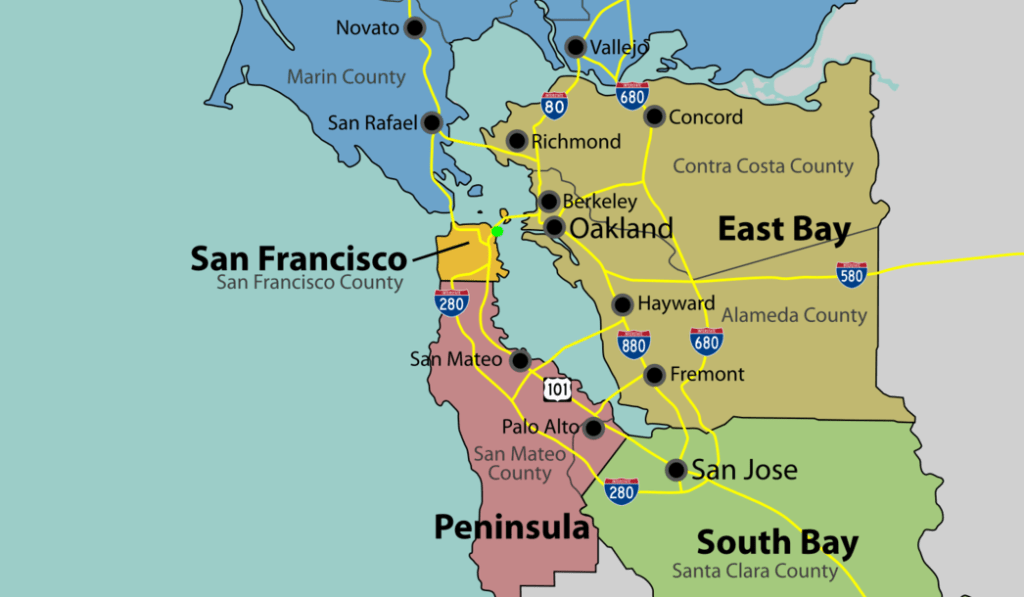
The lay of the land San Francisco sits on the tip ofa peninsula and Oracle Park is in the northeast part of town. Hold up your right hand. San Francisco is your thumbnail and the stadium sits right at the corner of said nail. Or just look at the map below that I swiped from Wikipedia. Oracle Park is the green dot. The stadium is in the China Basin neighbourhood, which is defined by McCovey Cove and Mission Creek. The area is a mix of old industrial buildings, multi-unit housing and the UCSF hospital/Chase Center campus at the far south end. It’s the flattest part of town (thank the lord!) and generally warmer than the foggy western part by the ocean. Keep your wits about you and you’ll be safe walking around at all hours.
This map shows the northeast area of San Francisco, including Market Street, the Union Square shopping and hotel district, “FiDi” and the larger South of Market neighbourhoods. You can see Oracle Park down there on the border of SoMa and Mission Bay in a small area known as China Basin. It’s like saying Target Field is in the North Loop part of downtown Minneapolis.
Where to stay Most of San Francisco’s hotels are in the downtown area. Hotels labeled “Union Square” are closer to the shopping district, ones labeled “Financial District” are on the eastern edge closer to the Bay. You might see others labeled “SoMa”, which is the general area south of Market Street (hence the name). Any of these will be at most 1.5 flat miles from the stadium.
I recommend not staying in Fisherman’s Wharf. It’s one of those places only tourists go and is a bit far from the stadium.
Getting to and from Oracle Park Transit Transit here is called “the Muni”. The Muni’s N or T train will get you directly to Oracle Park; the N drops you off right outside between 2nd and 3rd streets and the T leaves you a short block away from the Willie Mays Gate. Fare is $2.50. You can buy a “Clipper Card” right in Apple Wallet and tap it to the reader when you board the train. (I don’t know what to do on Android.) You can catch either train from the subway that runs under Market Street in downtown and it’ll take 10-15 minutes at most to arrive at the stadium.
Pro tip: When trains are packed after the game, walk one block west on King Street to catch the N at the very start of its route or two blocks south on Third Street (cross the O’Doul Bridge, you can’t possibly miss that) to catch the T train one stop before it hits the stadium. The cars should be more empty at these stops.
Walking Oracle Park is very easy to walk to, especially because it’s mostly flat in this part of town. Like I said above, if you’re in Union Square, FiDi or SoMa it’s at most a mile and a half.
Driving Never done it and don’t recommend it. Parking is hard to find and expensive.
Uber is of course always an option. 🙂 Put your pickup or drop off spot a block or two away from the stadium so you and your driver don’t have to fight traffic chaos. (Full disclosure: I work at Uber)
Okay now let’s talk about the stadium itself.
Oracle Park basics
Oracle Park has five levels:
Street—Where you enter.
Promenade—All lower level seats (it turns into “the arcade” in right field).
Club—What it says; akin to the Delta Sky Club.
Suite—What it says.
View—The upper deck, split between view box (lower, like the 200 level at Target Field) and reserve (above that).
The club and suite levels are restricted to those ticket holders, everywhere else is free to access. All entrances enter on street level, so you have to go at least one level up to get to your seats unless you’re in the Field Club or Dugout Club. There is one Jumbotron, located in centerfield. Oracle Park’s seating bowl extends from the right field corner to the left field corner. The outfield is one level (same level as the promenade, but they call it the arcade for some reason). You can walk a lap around the entire lower level.
Getting in and out of Oracle Park There are five gates at Oracle Park. The biggest gate—the Willie Mays Gate—is at 3rd and King, two are at 2nd and King, one is behind center field and one is at the right field corner next to the bridge. You can go in any of these gates no matter where you’re sitting. Security is almost always less than five minutes. A sixth gate near the Willie Mays Gate is available only to fans with tickets in the Field Club or Dugout Club; it will say one of those two clubs on your ticket if you can enter here.
Willie Mays Gate—Third & King Streets Located behind home plate, the Willie Mays gate is the only one with an escalator. It will take you to the promenade level. From there you can take an escalator to the club level or a longer escalator to the view level. Otherwise you have to walk up the pedestrian ramp that goes to every level.
2nd street gates—2nd & King Streets Located in the left field corner, the gates at 2nd and King do not have escalators. Fans who can walk will take the pedestrian ramp to any level, otherwise there is an elevator you might get to use (more on that later). There is a merchandise stand immediately inside the entrance. Note there are two gates here sort of like Gate 29 and Target Plaza in Minnesota. One is reserved for Go Ahead Entry, MLB’s new scan-less entry system. Sign up for that if you want the fastest way into the ballpark. For this to work, everyone in your group must sign up for Go Ahead Entry to be scanned individually or one person must have all the tickets in their Ballpark app. If you don’t want to do GAE, use the other entrance at this gate.
The Marina Gate—Centerfield Located in center field, the street-level Marina Gate takes you into a concession and gaming area underneath the batter’s eye. You can access left field bleacher seats from here. Otherwise the rest of the stadium is accessible from a tall flight of stairs that will take you up to the arcade below the Jumbotron.
The O’Doul Gate—Third & Berry Streets Located in the right field corner, the only option here is to go up a flight of stairs; it goes to every level. You can also use Go Ahead Entry here.
The Blue Cross Gate—Third & King Streets Located right next to the Willie Mays Gate, this will take you directly into a food court. Go thru there to access field club seats or to find the secondary entrance for the dugout club (like the Champions Club, but much smaller). You’re at field level here. To get to any other level you must go up to the seating bowl and take the aisle to the promenade (where you would come in if you take any other entrance). Again you can only use this gate if your ticket says so.
Getting around inside Oracle Park Oracle Park has a lot going for it. Internal mobility is not one of those things. It’s under-built with only one bank of escalators, limited stairs and elevators they would rather you not take (you can always try, but I’ve seen plenty of instances when the operators direct able-bodied fans to the ramps or stairs). In other words, this is not Target Field.
Here’s how and where you can move vertically: Escalators: Behind home plate; one takes you from street level to the promenade, another from the promenade to the club level and another (longer) one from the promenade to separate for the view level; Stairs: Behind home plate starting at the promenade level, behind sections 128/228/328, and in the right field corner; Ramps: Behind home plate, left field corner; Elevators: All gates.
Moving horizontally isn’t always easy either. The concourses are tight and filled with vendor stands, especially on the promenade level. There are two main choke points: Behind home plate where the press box, fan service and multiple concession stands constrict the space as fans come up from the Willie Mays Gate, and in left field under the Coke bottle. Giants fans are a late arriving crowd, so give yourself extra time to move if it’s close to game time. The view level isn’t so bad unless the game is sold out and that’s very unlikely.
Eating at Oracle Park Oracle Park has a few great items below but not the breadth of what Twins fans are used to at Target Field. If you have to or want to eat in the ballpark, I recommend the following:
The Organic Coup—left field corner, lower deck. Decent chicken sandwich or chicken tender bites with tots. There are a lot of tenders in the basket and have a great meat-to-breading ratio. Better than the standard concession chicken tenders for sure. Tony’s Pizza—right field corner in the upper and lower decks; Field Club; Alaska Airlines Club; directly inside the Marina Gate. From legendary San Francisco pizza magnate Tony Geminiani, a huge piece of pie here is probably as good as ballpark pizza can get. It’s also exactly like the pizza you get at Tony’s Slice House, not some bastardized concession version. Elite shit. Flatbreads—center field batter’s eye (by the Marina Gate). Under the Jumbotron in centerfield you’ll find a flatbread shop. I like the sausage one. They make it fresh so let it cool a few minutes before digging in. All beef hot dog—Regular stands everywhere. Make sure you get the all beef. It’s better than the hot dog at Target Field but no Dome Dog. RIP Metrodome and RIP Dome Dog.
You’ve probably heard about the garlic fries. I recommend a hard pass. They’re soggy and really just a massive sodium bomb that will leave you with bad breath and unquenchable thirst. In my opinion you can also pass on everything else, especially the crab cakes. They smell horrid if you’re unlucky enough to be near a fan who partakes. Keep in mind the author hates seafood.
If you arrive late or just don’t want to wait in line, Oracle Park has a partnership for ordering thru Uber Eats. Scan the QR code on every seat to bring up the concessions menu in the Eats app and place your order with no fees. Fans in the premium field club can enjoy in-seat delivery. Fans in the rest of the stadium can go straight to the pickup station at the stand they ordered from. Much faster. (Again disclosure that I work at Uber.)
If you’d rather eat outside the ballpark you’re in for a treat. Wherever you’re staying or coming from, open Maps and search for restaurants. You’ll find countless options. Here are a few that come to mind within a short walk from the stadium: Frankie’s, Hi-Dive, Red’s (brunch and lunch only), Candlestick, Atwater Tavern (across McCovey Cove a short walk thru the beautiful new China Basin park), Underdogs, Local Tap, Towns End Brunch (closes at 2pm). I’m sure there are many more. The Saturday game will probably get over around 7:30, leaving you plenty of time to score a rezzy at any one of San Francisco’s amazing restaurants. This is a great food town. Take advantage.
You can also bring food into the stadium if you want, provided you comply with the stupid (and sporadically enforced) clear bag policy. Empty water bottles or sealed water is also fine. The pro move is to buy a $2 water bottle from one of the vendors outside or just bring an empty bottle.
After the game (and probably before) you’ll get to experience the uniquely San Francisco treat: Dirty dog vendors. These portable food carts fry up bacon-wrapped weiners with onions and peppers. The author cannot stand the smell much less the thought of putting one in his stomach. If you’re feeling brave, go for it.
Where to sit
Like I said, time of day greatly changes the seating experience here so I’ll go over each game.
Friday night Sun/shade. Everything will be in the shade except the far reaches of the outfield bleachers, which will have sun for the first few innings. This’ll be tough to stare into but won’t make you hot. Temperature. If it’s a normal San Francisco summer day with high’s in the mid-60s to low-70s then expect a chill in the evening. I recommend at least a light jacket. Things to watch out for:
Wind. If it’s an exceptionally windy day then the stadium will get cold after sunset. To stay out of the wind, look for seats toward the middle of the stadium or under the overhang in the lower deck (roughly row 33). Avoid the corners of the stadium and the outfield as you will feel the full force of a wind whose cold you can’t begin to fathom.
Abnormally high daytime temperatures. If they day time temp is more than 80 degrees then chances are we will have a warm evening. You wouldn’t need a jacket in this case and it also wouldn’t be windy.
Bone-chilling cold. If it’s a cool day, like low-60s or below, be prepared for a level of cold you have yet to experience even as a Minnesotan. I will come to the ballpark with at least three layers (one of which will be a hoodie), knit gloves and a stocking cap on nights like these. Do not, under any circumstance, come to the game in shorts and a t-shirt. You are not—and I want to make this very clear—you are not tough enough to handle this just because you are from Minnesota. That means nothing to the cruel ocean wind. Your best bet is to pay attention to Giants fans outside the stadium. If you see them in jackets or carrying big blankets, it’s going to be a cold one.
Saturday afternoon Sun/shade. There will be some sun in the far left field upper deck and full sun on the entire outfield at the start of the game. By the end only the far centerfield bleachers will be still facing the sun. Like Friday, it will be sun that’s annoying to look into but not enough to make you hot.
Temperature. 4:15pm starts are tough because you have to anticipate daytime and evening weather. Since most of the stadium will be in the shade, I recommend dressing as if it’s a night game with pants and a light jacket. Take note of the wind also; same guidance as Friday night. Same guidance also on what to do if it’s abnormally warm.
Sunday afternoon Sun/shade. This is when sun and shade will really matter. If you sit in the sun, the sun will be hotter than you expect. You will get by fine in shorts and a t-shirt. In the shade, on the other hand, it’s tough to anticipate. I’ve had shaded seats that are perfectly comfortable and others when I’ve wished for a jacket. My best guidance is to tie a lightweight long-sleeve shirt or jacket around your waste just in case, and then put it on if you get chilly.
So where should you look for sun and where should you look for shade? I’ll offer guidance by level. But keep this in mind: Shade starts in the right field corner and works its way around toward the left field corner.
Field level. Anything above row 34 will put you under the overhang and in shade the entire time. Rows 31-33 might be covered depending on the section but you’re for sure safe in 34 and above. Note also the very last rows of field level have an overhang will block fly balls and the centerfield scoreboard. They hang TVs to compensate. Below row 31 you’ll get shade sooner on the right field side and later on the left field side. The closer to the field you go, the more likely you are to be in the sun the entire time.
Club level. The last 4-5 rows should be fully shaded the whole game But in general the same principle applies as field level. If you want shade, go higher up and toward right field.
View Box. So this is the lower part of the upper deck, similar to the 200 sections at Target Field. These are low enough that they’ll be in the sun almost the entire time all the way around the stadium. But pay attention to your row and the number of rows in your section. The last row in view box will get shade from the barrier behind it.
View Reserve. The upper upper deck, akin to Target Field’s 300 level. Same applies as the other levels—Go higher and toward right field if you want shade faster; go lower and toward left field if you want sun.
Now that you understand how where you sit will affect the temperature, let’s talk about where to actually sit!
Places and views
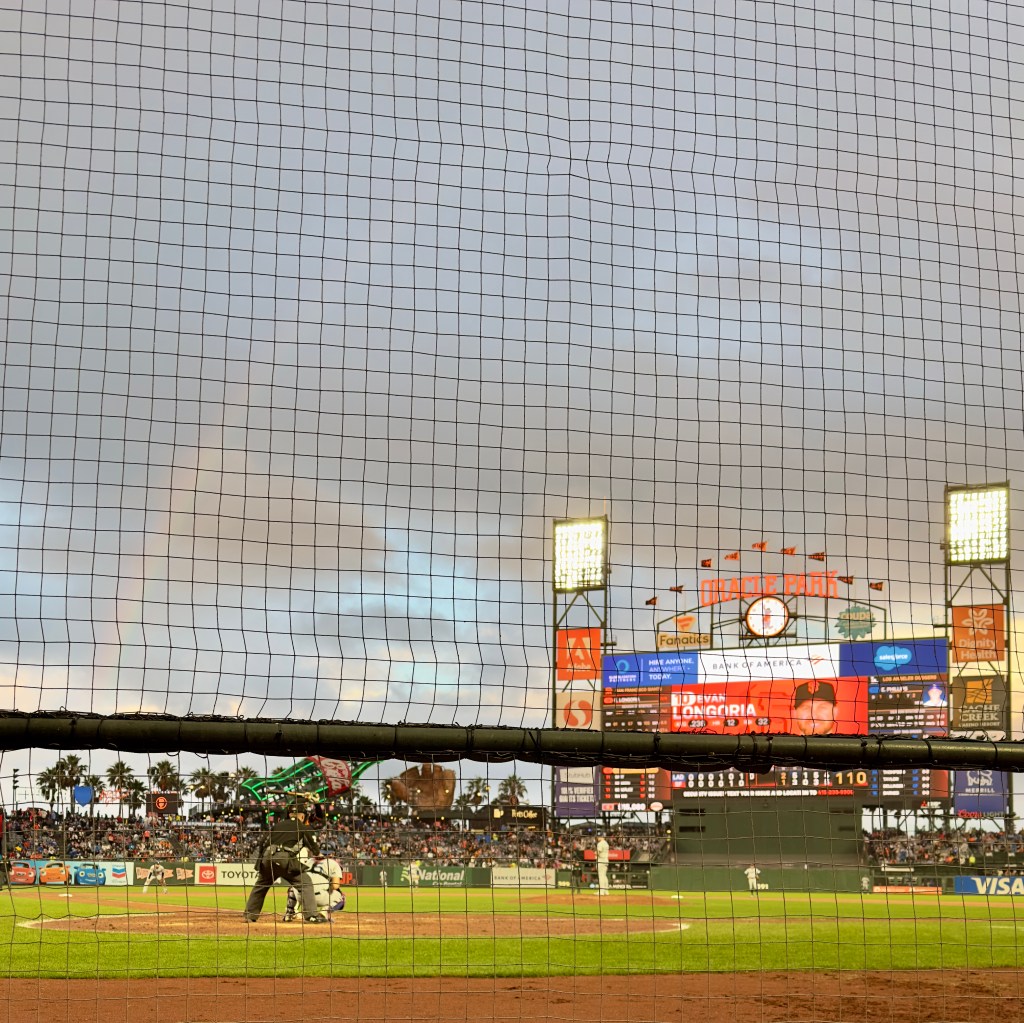
Oracle Park is known for its sweeping views of the San Francisco Bay, but they’re not available from every seat. You can’t see the Bay at all from the field level, but you do get a glorious view of baseball and nothing else:
The view from section 116 at Oracle Park.
You can sort of see the Bay from the club level, but it’s not an amazing scenic vantage point.
The view from section 216 at Oracle Park.
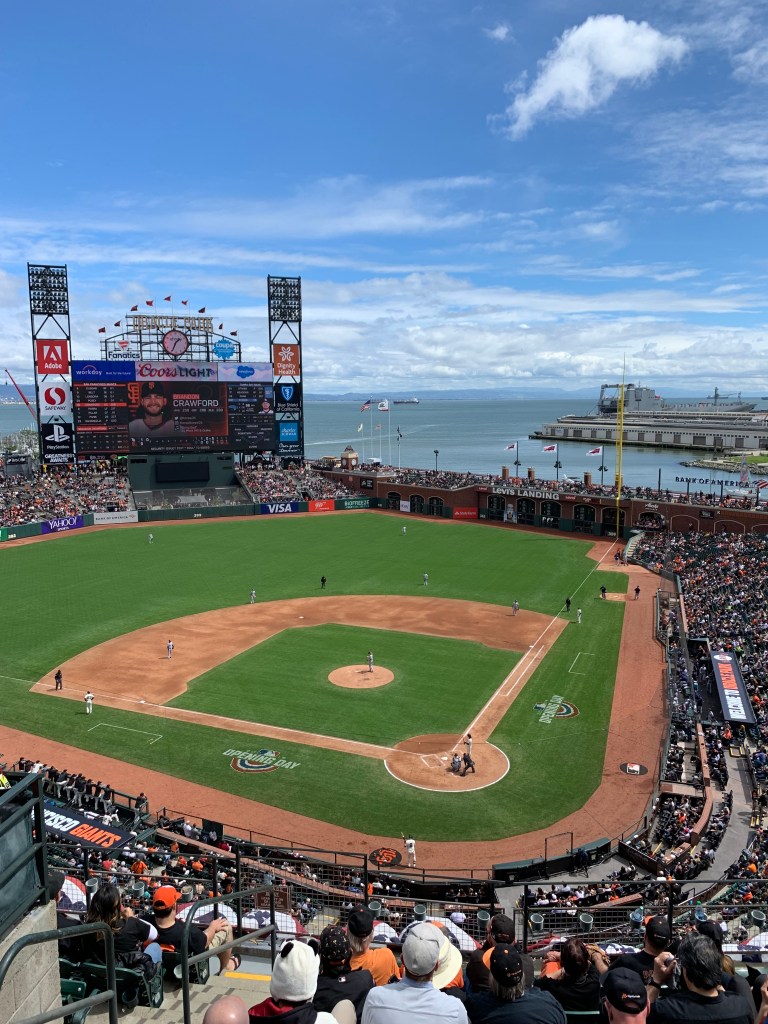
For that you have to go to the upper level where you get the view from the image at the top of this post. Upper deck on the third base side points you south toward some delapidated piers; not breathtaking but not bad.
The view from the upper deck looking south.
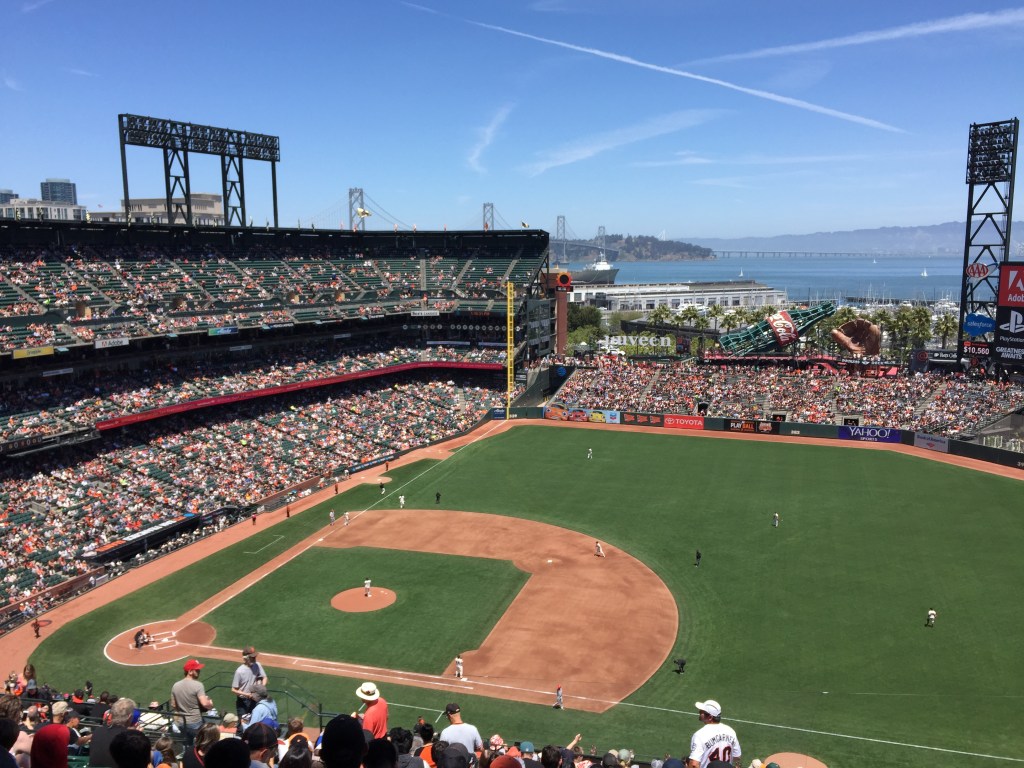
The first base side points you toward the Oakland hills and, if you’re really far down the line, the Bay Bridge. This will be a great view on Saturday and Sunday, but only average on Friday. (Back when we could afford to run lights on the Bay Bridge this was a stunning night time seat). Sitting even with home plate in the upper level will give you a view of the hills and the Bay. Keep in mind there’s not much out there to see at night. If you want to sit lower and close to the field for one of the games, pick Friday night and go for the spectacular views during the day games.
The view from the upper deck in rightfield looking east.
Like any ballpark, the view gets extreme when you’re far down the foul lines. I personally don’t care for this sight line. But I will note that the promenade seats in the far right field corner are elevated enough to provide a decent view. Be warned, however, that you will be exposed to the wind there.
There are no restaurants or bars inside Oracle Park. The closest thing is the 415 Club behind the bullpens in centerfield. But even that is nothing like what Twins fans are used to at Target Field and why, in my opinion, Target Field ranks slightly ahead of Oracle Park in general.
Premium seating
The Alaska Airlines Club Level is similar to the club level at Target Field. Sitting here gives a nice compromise between Bay views and game views. Don’t expect premium food or amenities though. It is mostly the same as everywhere else in the ballpark and there are a few things you can’t get on this level.
Lower level premium Field Club seats come with stadium access through a separate entrance and a separate concession area with the same food as everywhere else. Think similar to that separate section of seats behind the dugouts at Target Field, but with their own stadium entrance. The main benefit here is the dedicated access and concessions. You’ll also have your own bathrooms.
Dugout Club is Oracle Park’s equivalent to the Champions Club. Food is included, drinks are not. Don’t expect premium dining; it’s a sampling of concession food from around the ballpark. The club area is a converted umpire’s dressing room and feels more like a lounge than a restaurant or club. The view from here is very close, but it’s also low to the ground. Some of the seats by the on-deck circles are actually below field level. It’s cool, but know going in it’s going to be a weird vantage point. Also note the Twins will be in the first base dugout.
A view from section 113 in the Dugout Club at Oracle Park.
Above the right field wall is similar to the overhang seats at Target Field. If you go too far toward right-center you’ll start to get a weird angle. Err on the side of going farther toward the foul line.
Let’s go deep on seating details now. These are my personal secrets so please don’t share them with Giants fans who might steal the good seats from me the rest of the year. – Be careful about section 315 in the view box level. TV cameras are stationed there and anything row C and above risks being stuck behind them. If you’re picking specific seats from the Giants website just stay close to the aisles. If you’re buying by row from a resale site go for row A or B. – In the club level, view box and view reserve you need to be at least three rows back to avoid being obstructed by the railings. The second row might be okay in the upper levels depending on how tall you are. – Seats numbered one through about six in section 119 are offset at a weird angle that points you toward the visiting dugout. – Section 110 and 121 also have a weird seat alignment. – Sections 106-7 have a standing bar in the back so there can be drunkards hollering sometimes. Same above the batters’ box ad display on the third base side. – Be careful with sections in the far left field corner. Section 132 and 134 merge at the bottom, with 132 angled towards left field and 134 angled towards the infield. 133 is stuck in there like a pizza slice. Section 103 in the right field corner is similar but without the pizza slice. – In section 310 sit closer to the homeplate side of the section (higher numbered seats) – Longer View Box sections 310, 313, 315, 318 and 321 are good but the higher you go the closer you get to the View Reserve and basically pay a premium for the exact same view.
If you already have seats or are curious about the view from a certain spot, drop me a DM. I’ll try to get a pic for you next time I’m there or will check the sun/shade situation during an afternoon game.
When the game ends, leave. You’re on your own now!




 The Wandering Lostie