An open letter to LPGA Commissioner Craig Kessler.

Hi, Craig

Golf’s future in my life was teetering on the edge in 2017. A hip injury prevented me from playing. Tiger Woods was pretty much over. I was not far from becoming someone who only watched The Masters. 

Attending that year’s Solheim Cup at Des Moines Golf & Country Club changed everything. Watching those 24 players interact with fans and play great golf reignited my love for the game. Plus I actually got to see them play, the Ryder Cup where I mostly saw the back of other people’s heads. I won’t say this turned me into an LPGA junkie, but in the years since I’ve been to women’s tournaments at Pebble Beach, Harding Park, Sharon Heights and Riviera. I’ll be back at Sharon Heights again next March, at Lake Merced Club next September and if there’s no baseball season to travel for maybe I’ll head to Inverness or the JM Eagle. When I have a choice of what golf to watch, I almost always choose to watch the LPGA.

So that’s where I’m coming from here. 

Listening to your interviews, I think you understand the opportunity and the challenge you face. As a fan who believes the Tour can still capitalize on this moment, here are five things I want you to consider. 

One: Marketing aggressive messages. I’ve heard you say the LPGA is a disruptor brand, and you’re right. Back that up with the way you message and market the Tour. 

Modern audiences reward believers who refuse to back down. They want you to stand for yourself. Do it. Assert a world where Nelly Korda has the best swing on the planet and defend that assertion against all doubters. Challenge the assumption that the best golf on Sunday afternoon is played by men. Challenge the assumption that driving distance is a prerequisite for great golf. Mock the foolish notion that a man with a three handicap could hold his own against Ayaka Furue. 

Your best marketing message should come with the risk that golf bro Twitter laughs at you for it. Find it and stand behind it. If you do, I think you’ll see the LPGA increase its share of attention across mainstream and social media. That’s a key part of creating a flywheel you need to grow the Tour’s stature in the game and in sports culture. 

Two: Forcing great courses to tell you no. I’m glad the Tour is back in the Bay Area but let’s be honest: Sharon Heights isn’t going to attract attention. Cal Club would. San Francisco Golf Club would. Cypress Point and Seminole sure would. They might laugh at you for asking, especially now with the PGA Tour potentially trying to get in. But you can offer all these clubs something the PGA Tour can’t: History. So go after them like a believer. Ask them this question point blank: 

How can you be one of the world’s greatest courses if a woman has never won there? 

If they don’t want an annual Tour stop, tell them hosting every five years is okay. The Tour gets the attention that comes with playing them, the clubs get a legitimate place in all of golf’s history. Win-win. 

Three: Wait…tournaments rotating to prestige courses…did I just describe a major? I think so. 

We need to talk about The Chevron. It’s great that Chevron put a massive amount of money into the tournament. Now it deserves a better course that connects it to golf history. Memorial Park can’t deliver that. It also hosts a men’s tournament only a few weeks earlier. Stop riding the coattails of a mid-tier PGA Tour event. 

I understand you’re trying to build something in Houston, and that’s laudable. But again I encourage you to think more aggressively. Why do you have to build anything? A believer would act like the LPGA deserves to host its major at a more famous course…because it does.

(If Chevron doesn’t like that because it’s easier to throw hospitality parties in its corporate hometown, then maybe Chevron isn’t the right partner for you after all.) 

In addition to the stunners I mentioned earlier, potential courses can easily be found in the list of sites that can no longer regularly host mens tournaments: Olympia Fields, Medinah, Cherry Hills, Castle Pines, Firestone (which is about to lose its senior event) and Cog Hill to name a few. 

Three(b): Don’t forget about made-for-TV match play. This opens up an entirely new category of courses. Think Sand Hills, Fishers Island, Friar’s Head or Ohoopee because you won’t need to transport or support thousands of people on the groups for multiple days at a time. Now imagine matches not covered like traditional golf broadcasts, but produced like theatric films. 

Four: Claim Hawaii. The PGA Tour opened the door wide open for you here. Make Kapalua yours and tell Wai’alae that we all know Tiger Woods is never traveling to Hawaii for a seniors event, so there’s no reason to take the PGA Tour’s consolation prize. If it won’t budge, find another great course to schedule after Kapalua. Then market the hell out of being the top tour playing golf in Hawaii. Because you will be.

This can fit neatly into your existing schedule. If you’re willing adjust the timing at Lake Nona (or give it one of your fall events) the LPGA can be the tour that starts its season with primetime Hawaiian golf. That also makes it a lot easier for your players to travel for the first Asian swing. 

Five: Figure out streaming. I know Golf Channel is the only place that carries the LPGA, and that’s fine. But I have no idea when it’s on. Find a way to get your broadcast partners to have a consistent TV window. I won’t pretend this is easy; the economics of your media partners are miserable. But you’ve got to find a way to give current and potential fans a consistent way to easily find your product.

At the risk of 20/20 hindsight, I’ll say that all of this would have been a lot easier four years ago. Previous Tour leadership is at fault for not capitalizing on the mens game tearing itself apart. Be the aggressive advocate and believer those leaders weren’t. 

I truly want you to succeed and for the Tour to succeed. Watching the two Asian swings in primetime on the west coast is a highlight of my sports year. One of these years I will make a point of attending each. 

I wish you the best. 
Let’s not get Lost in Severance

“The most important part of your life was the time that you spent with these people.”

How many of us were so caught up in the mystery and minutiae of The End that we barely registered Christian Shepard’s words to his son, Jack? My mind was racing thru what mind-blowing reveal might yet come in the few minutes we had left. I wasn’t in the right headspace to realize Lost had just laid its meaning bare after six mind-bending seasons.

This occurred to me early in the second season of Severance on AppleTV+. People are saying it’s the most engrossed they’ve been since Lost, and I believe it. Last week on Threads there was a whole trend of people breaking down the elevator dings for each character. If that doesn’t remind you of fans obsessing over Lost’s blast door map, I don’t know what will.

They’re even coming up with some, um, theories:

  • Mark’s outie is actually the severed one and everyone in his life is a Lumon plant;
  • Cobel is Mark’s mom;
  • Ms. Huong is Mark and Gemma’s child;
  • Cobel is a robot (or should I say, an ORTBO);
  • The pineapple is a trigger that makes outies more compliant;
  • Dylan and the door factory manager look alike for a reason;
  • They all drive old cars because the show takes place in an alternate timeline;
  • They’re Mormons;
  • Kier Egan is going to be reincarnated into Mark’s body; and
  • This is all a ruse to trick Christopher Walken into saying he needs more Cobel.

I have theories, too, and I’ll talk about them shortly. But I watch Severance in a world in which Lost existed. I don’t want to miss what this show is really about because I’m so focused on what it’s not. Goats? Not even a little bit interested. But I do care about Helena and Helly reckoning with their shared autonomy over one body and how Dylan G is accidentally ruining his outie’s marriage. 

And, of course, I care about Mark S. Every great story is about the obstacles between its characters and what they want the most. We entered Mark’s life two years after he decided he wanted to be free of grief—for eight hours a day—by undergoing the severance procedure. That was going okay for him until the characters around him instigated a series of events that gave him the opportunity to want something more: Gemma back. He was so motivated to pursue this want that he was willing to fry his retinas and scramble his brain for the chance to see his wife again (no, of knowing he was seeing his wife again). 

But again it’s not a great story unless something stands between Mark and what he wants. This is my theory about Cold Harbor. I believe macrodata refinement tunes the severance chips to block specific emotions from their recipients like how a programmer trains an algorithm to accomplish a task. The emotion in Mark’s case is grief. As we near the end of season two, his innie is 96 percent done with the Cold Harbor file, which will give Lumon a way to permanently remove grief from the human experience (without severing the rest of their memory). That’s the kind of lofty achievement that merits saying it “will be remembered as one of the greatest moments in the history of this planet.” 

And there we find drama: Mark’s innie is unknowingly about to give Mark’s outie his freedom from “choking on Gemma’s ghost”, but Mark’s outie is unknowingly screwing that up by pursuing a risky reintegration treatment that will render Cold Harbor ineffective. Dammit! Great storytellers absolutely torture their characters, and what could be more torturous for Mark to know that he could have been free from the grief of losing Gemma if he hadn’t tried to reintegrate? Bad for Mark, compelling for us! 

I think Lumon even suspects Mark is working with Reghabi, the mad scientist behind reintegration who already fatally experimented with another severed Lumon macrodata refiner. That’s why Helena happened into the same Chinese restaurant Mark did after a recent procedure. Calling Gemma by the wrong name was a test (Mark’s innie wouldn’t know her name) and Britt Lower giving her Helly face straight to the camera a clue to viewers that Helena was, once again, not being honest with us. 

This is also what made the most recent episode “Chikhai Bardo” so frustrating. The show had to tell us Mark and Gemma’s story and what happened when Gemma/Ms. Casey was sent back to the testing floor in season one. But with only 10 episodes, the show doesn’t have time to take scenic detours unless they lead somewhere concrete. And this one didn’t. All we really got was 1) a very vague look at what Gemma’s life on the testing floor and 2) that Mark didn’t die from his stroke at the end of the previous episode. Instead it just threw more unanswered questions at us: Did Gemma go to Lumon willingly? If so, why? What is the purpose of the experiments Ms. Casey is forced to undergo? We got some hints, including our first look at the team supervising the refiners, but it was told in such riddles that even Gemma got fed up with it. By the end of the episode, so was I. 

*This episode was visually stunning—especially considering it was directed by Jessica Lee Gagné, the show’s cinematographer, in her first time behind the camera. Shower her with awards.

To go back to my original point, you’re not reading my thoughts about where Lumon is located or if its board is a disembodied consciousness. Or those damn goats. I don’t even really care if  Burt worked at Lumon for 12 years like he believes, or 20 like his “husband” insisted during their dinner with Irv’s outie. 

If you’re a viewer caught up in things like that I encourage you to listen to the official podcast with Ben Stiller and Adam Scott. They aren’t talking about clues to unraveling mysteries. They’re talking about the actors’ performances—what their characters are thinking and feeling as they move through this cryptic world. 

That’s what this show is really about, and what I’m trying to care about. Mark wants a break from grief. Dylan wants a piece of the happiness he believes his outie has. Helly wants the free will her outie refuses to believe severed people deserve. Being obsessed with anything else is a fruitless exercise, just like it was during Lost. 

Lost: 10 years after the journey

10 years ago tonight Jack Shephard laid down in the bamboo and closed his eyes. 10 years since I sat stunned in my TV chair thinking that’s it? Really??? It was about their journey??? I was not happy.

Little did I know on Sunday, May 23, 2010, the events that would affect the course of my journey were already in motion.

The next morning my bus broke down, which had never happened in the six prior years of my #buslife. Then our replacement bus broke down. 2-for-2. Did everything fall apart when Desmond pulled the plug??? When the third bus finally picked us up I half expected to see Hugo Reyes behind the wheel of my trusted route 53. Wouldn’t that have been a hoot.

I finally got to work at my job leading comms for the Republican caucus in the Minnesota House of Representatives. The legislative session ended the week prior with a budget stalemate and a brewing electoral battle over Obamacare. We intended that to shape the coming campaign season, and boy did it ever.

We rode a wave to historic electoral success in the Legislature but fell just short of claiming the governor’s race. Had we done so, the next two years would have been an incredible high. Instead they were probably the most challenging, frustrating years of my career. Halfway through the next election—2012—I knew I was ready to walk away.

Maybe I would have stayed if things went our way that year. But as Miles Straume said, “Whatever happened, happened.” We got our asses kicked. My time was up. A new chapter of my journey was about to begin, 899 days after the Lost finale.

Other than not politics I really didn’t know what I wanted to do with my career then. I never wanted to be a political lifer and with nothing but political experience on my resume at age 32 I knew the longer I stayed in the harder it would be to break out. I can only wonder how different my life would be today if I’d taken any of the opportunities I had over the next few months to stay in that world.

To be honest with you, I was not very good at being unemployed. Public relations and communications was the logical next step, so I spent months doing the lazy thing and applying for online listings at companies or industries I thought would be fun. Sports, aviation, business. PR agencies didn’t really strike my interest, but most of the locals had something I applied for at some point. Online listings funnel your resume into a soulless void of online tracking systems. I’m not sure anyone has ever gotten a job that way. The real way to find a job is to network. I am terrible at networking. In fact, I basically don’t do it. People. Ugh.

Except at some point in the mid-2000s I fell in love with online communities. There I could network my ass off from the place I was most comfortable: Behind the keyboard. Everyone else was behind the keyboard, too, so I didn’t have to feign interest in small talk. Or talk at all. I was here for it when social media emerged, and I joined Twitter on September 25, 2007, some 972 days before the Lost finale.

That one little act, so insignificant at the time, altered my journey perhaps more than any other.

Twitter and I fit hand and glove. You couldn’t write more than two sentences in a tweet and most of my thoughts aren’t more than two sentences long anyway. Social media’s rise coincided with my rising position within the caucus. By the time Lost ended I was not only the caucus media director, my tweeting was getting me interviewed on TV and invited to speak on panels. My stupid little profile icon even got me recognized when one lawmaker ran up to me in the Retiring Room to ask, “Are you Kwatt from Twitter?”

Sure am. Do you remember the campaign brochure that popped up in your district, the one designed to look exactly like your local newspaper but was full of reasons to vote against you? That was me, too. Turns out I sort of invented fake news. Sorry. But I digress…

By the fall of 2013 I wasn’t sure I’d ever work again. Then one afternoon an email popped up from a Twitter friend who was writing a story profiling prominent local Twitter users. She wanted to include me. Sure! That’d be pretty cool. So she sent me her list of questions.

I was doing some light freelance work at the time and found myself in the southeast corner of Minnesota one Tuesday. With a few hours to kill between meetings I set up in a local coffee shop and started on my responses for the article. When it came to “What do you do for work?” I paused.

Should I put that I don’t have a job? Naw, that would be cheeky. Wait. You idiot. This is going to get published. Treat it like an advertisement—for yourself. Yeah! So that’s exactly what I did. “Kevin Watterson, age 32, currently looking for a PR job. Previously did PR and communications in the state Legislature.”

Months passed and I forgot about the article. It finally appeared on January 1, 2014. A few weeks later, Kathy Jalivay came across it. Kathy was the head of PR at a marketing agency in St. Paul and just so happened to be looking for someone looking for a PR job. On February 12, 2014, I joined her at Aimclear. I was unknowingly familiar with the office: I stood outside of it every night for the last six years waiting for the route 53 bus to take me home. It was 1,362 days after the Lost finale.

My journey through Aimclear was fantastic. I met awesome people and learned more than I could have ever hoped. At one point I was the Twitter voice of Firestone auto care, handing out coupons for a discount oil change to people who posted the best #roadtrip pics and making the best tire puns. Clients came, clients went. Some were more fun than others. Such is agency life.

My journey rolled on outside of work for those five years, too. I became an uncle. I got some things right, I messed up others. I traveled. Even took my first winter vacation, having been tied to the Legislature from January through May for all those years.

Then in January 2018, Uber called. They needed someone to cover social media while one of their OGs was on sabbatical. They already had one Aimclearian and wanted another. I landed in San Francisco and walked in the door at Uber for the first time on February 13, 2018. It was 2,824 days after the Lost finale.

They must have liked what they saw because by June 1 I was living in San Francisco full-time (2,932 days) and on March 4, 2019, I badged in as an official Uber employee (3,208). My longtime goal of moving to California was complete.

That’s where I remain. Things are good. Once I got settled I decided to live a life that would make my 14-year-old self jealous. So I set a personal record by attending 41 baseball games last year, 29 of which were just down the street at Oracle Park. It’s the Giants, but the Dodgers visit nine times a year and LA is a short flight away. I lounge by the pool for hours reading books. I watch TV whenever I want. I go see the ocean at least once a month, although that’s been hampered by this f*cking virus. Sometimes I walk outside and stare across the bay just to see mountains. I’m from Iowa, so yeah the Oakland hills count as mountains. I spoil my nieces (kids love scratch off lottery tickets, btw). I even own three pairs of Air Jordans just to display on my shelves. Take that, 14-year-old Kevin.

I can’t predict where my journey will go from here anymore than I could have predicted it would lead me here. Maybe in another 10 years I’ll be somewhere else, making 39-year-old Kevin insanely jealous.

It has been 3,654 days since the Lost finale. I get it now.

13 Questions For Joe @Buck

I like Joe Buck. A lot. I rated him one of the best baseball play-by-play broadcasters earlier this year and would put him near the top in football as well (he’s the head man for both on FOX). Buck comes to town for Vikings games from time to time and I’m always bothering him on Twitter to see if he’d like to grab a beer and talk broadcasting. He never responds, so I wrote up some questions I would ask him (along with my two cents) if we sat down for a drink.

Do you think growing up in the TV era has changed the way play-by-play callers learn their craft?
I believe it has. For many of today’s announcers sports have always been consumed in a visual medium where broadcasting is often less descriptive, and it means they’re less descriptive as broadcasters. You can really discern this when listening to younger radio announcers call baseball games.

Does a broadcaster have to be old to be “beloved?”
I read a great article on Verne Lundquist the other night and this question came to mind. I think you have to be a sweet old man before we can really feel like friends.

How much do you call looking at the field vs the monitors in your booth?
I wonder this most about baseball. Football seems like it could be called on the view from the booth, but pitches seem like they’re more easily seen on a monitor than up high where you can’t always discern their break.

By the same token, in football, how much can you see and what do you have to rely on spotters for?
It seems like it would be very difficult to be glancing away from the field to see what a spotter is telling you but they always get it right who made a tackle or who was the intended receiver.

What kind of work goes into your preparation? How does it differ than what your color commentators do for prep?

Do you think baseball broadcasts will ever move away from traditional stats?
I think if TV started showing more of the alt stats more fans would accept them. It would require broadcasts commit to giving time for explaining them. Personally I’d like to see more of these stats but I need to know what they mean and what’s a good number vs a bad number. An .850 OPS doesn’t tell me anything if you don’t also explain what a good OPS is.

You’re doing golf now, where traditional play-by-play doesn’t really exist. How is that different for you in terms of your style and how you have to prepare?

How has replay changed the way you call close or questionable plays?
Watching, I feel like sometimes an announcer is hesitant to make a full-blown call on a play if there’s a chance the play will go to a review. Baseball and football.

Are there any sports you haven’t called that you’d like to? Either because you like the sport or you think they would be fun?

Is doing play-by-play in a national broadcast different than local?
I think some color commentators, Ron Darling comes to mind, are much better locally than nationally and wonder if there is any difference from a play-by-play perspective.

How often is someone talking in your ear? Conversely, how often do you have to talk to them while your partner is talking?
Always wondered.

In football you reference when you met with players and coaches the night before a game. What do you ask about in those meetings and how do we see it on the broadcast?
How much of what you plan to talk about in a broadcast never makes it on air?
I’m thinking about games when there’s too much happening to really get into a lot of conversations outside of what’s happening on the field.

When FOX put that score box on a football game for the first time, how much did that alone change how games are broadcast (considering that now it’s in every sport)?

Amazon vs Netflix: iPad App Viewing Experience

I only subscribe to Netflix when there’s a show I want to watch, which lately means a new season of Longmire or House of Cards. Being a month out from the later – read my thoughts on season four here – I logged in tonight to cancel until Longmire comes out in September.

For the last year and a half, Amazon Prime has been my streaming provider of choice. You could debate which one has the better television library. Prime has the HBO library, I think Netflix has more Showtime archives (it’s an add-on to Prime). Netflix probably has more heralded original content with House of Cards and Orange is the New Black compared to Transparent as Prime’s most notable show. Unless you consider The Man in the High Castle notable for being awful. Prime definitely tops Netflix for streaming movies. The point is, which has the better streaming library depends on what you want to watch.

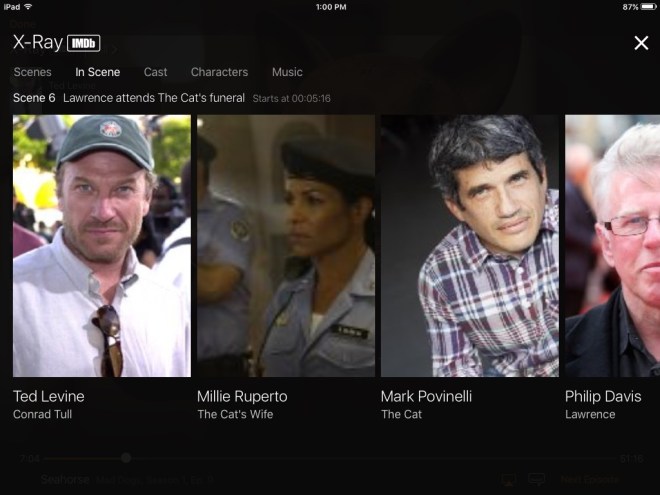
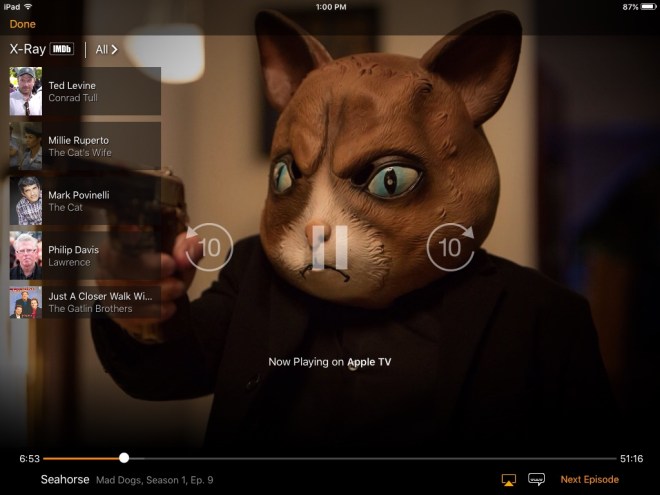
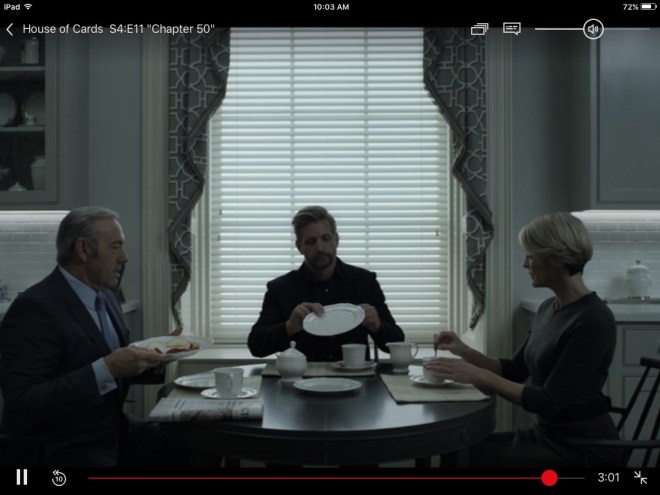
But after using both, it’s definitively the case that the Prime viewing experience in the iPad is far superior to Netflix. Here is a screenshot comparison.

Prime has several overlay options for navigation and information. You can hop forward or backward by 10 seconds while Netflix only lets you go backward. Both let you turn on closed captioning, and Netflix has an option to jump straight to a different episode (upper right, to the left of closed captioning).

From there, Prime leaves Netflix in the dust. Prime has an awesome overlay feature it calls X-Ray. Powered by the IMDB, X-Ray delivers everything IMDB knows about what you’re watching: actors, music, trivia and characters. It’s a fantastic feature, especially if you’re the, “Hey, wasn’t she in…” type. Which I am. I enjoyed it most when I was watching X-Files, which I eventually gave up because it was boring. But before that I swear every episode had an actor who went on to appear in some other show I watch. It’s like the Bill Walsh coaching tree of television.

Netflix:

Netflix House of Cards Season 4 Screenshot

Prime:

IMG_0408 IMG_0407

You’ll notice the second Prime screenshot is when using Airplay to send it from the iPad to Apple TV. Lack of an Apple TV app is Prime’s biggest shortcoming if you’re in the Apple universe, but Airplay works just fine and an app is surely coming.

This isn’t intended to be a total Prime vs Netflix comparison because that would surely entail a much deeper look at their catalogues and pricing. But if you are keeping track at home, Prime has one feature Netflix can’t match: Offline viewing. Prime lets you download TV episodes and movies to your device to watch offline, such as in the car, on the bus or at the gym. Netflix isn’t doing this, for the most preposterous reasons you can imagine.  Basically it thinks you’re too stupid and lazy to do it.

I won’t be re-upping with Netflix until the Longmire season five (season four ended with someone breaking into Walt’s house while he and his GF were getting friskay). Until then I’ll enjoy the superior viewing experience Prime offers and wondering why Netflix is so far behind.