Every season new shows pop up that I enjoy but don’t earn enough time and thought to warrant the kind of attention I give to Revenge, Person of Interest and others. I broke these into two posts, the second will include two shows that I never, ever in my wildest imagination thought I would talk about on my blog.
Part One: Sleepy Hollow, The Blacklist, Brooklyn Nine-Nine
Part Two: Agents of S.H.I.E.L.D., American Horror Story, and two surprises.
Sleepy Hollow – FOX Mondays
I came into Sleepy Hollow knowing none of the background. My ignorance made the first 45 minutes of the pilot pretty difficult as a headless horseman ran around town swatting heads of unsuspecting residents. The first to go was the sheriff who Lost fans know better as Kelvin Inman. What a let down.
The last 15 minutes roped me in. Mysterious devils appeared, a man got his neck snapped completely backwards. That’s what I’m talking about! I posted a snap reaction with more thoughts if you care to read them.
Sleepy Hollow has stayed pretty good since then but it is falling under the post-Breaking Bad hangover I mentioned in my Minnesota Bloggers Conference recap. After watching the crisp seriousness of Walter White’s story arc I can’t get into a headless horseman the way I could before the binge. I still enjoy it, but I don’t take it seriously.
James Spader as Raymond Reddington on NBC’s The Blacklist.
If any show on this list elevates to more regular postings it will most likely this one. I read the pilot script from Alias right before I watched The Blacklist for the first time and couldn’t help but feel some similarities. There’s spying, a young woman, some mysterious CIA and FBI types. Okay that’s probably where the similarities end, and I must confess to never seeing an episode of Alias. Give me a break, I needed an intro.
The Blacklist is a list kept by Raymond Reddington, played wonderfully by James Spader. “Red” went off the grid 20 years ago to live a life in the information trade, before suspiciously turning himself in in the series’ opening scene. He will only work with Elizabeth Keen, a young FBI profiler played by Megan Boone. It is not a coincidence that Spader’s character re-emerged on her first day with the Bureau.
The first few episodes give us a look into Keen’s past but not a complete look. Reddington is tantalizing her with insinuations that there is more to her life than she is aware of (that’s an Alias similarity!), starting with her new husband. After he is brutally attacked in their home, Red prompts her to find a box hidden under their floor. It’s full of passports. Suddenly the man with whom she is going to adopt a child is a suspicious mystery.
Each episode features Reddington trying to take down one of the international bad guy son his list of names. Each plot gives us a little bit more of the story so we know it is clear his targets are linked for some reason and the reason likely has to do with Keen.
I like The Blacklist because it gives the clear indication that there is a lot more to what we’ve seen in its first month. Give me a show with some depth, a few shady government types and some decent drama and I’ll give you my attention. I’m a little apprehensive about Spader’s character turning into one of the good guy/bad guy roles TV has become infatuated with (see: Ben Linus, Walter White, et al). But that’s a concern for another day.
Brooklyn Nine-Nine – FOX Tuesdays
Andre Braugher is back! I was excited for Brooklyn Nine-Nine only for this reason.
What a disappointment. It is as if you took the worst parts of The Office and gave it the most stale jokes Twitter has to offer. It is not funny or entertaining. After the pilot I proclaimed I would burn my television and move to Dubai if it got more episodes than the great Last Resort, Braugher’s 2012 fall effort. Brooklyn got picked up for a full season, so very soon I will come to you and admit I broke this promise.
Root serves a valuable role on Person of Interest. Harold Finch, The Machine’s creator, wants his baby kept hidden from the public and the government that uses it. Root is a hacker, not opposed to The Machine’s electronic dragnet but angry at Finch for keeping it locked away. POI fans crave more information about The Machine — what it looks like, where it is, how it works — information that Finch would never give us. Root is the fans’ voice for wanting those answers and the driving force behind the stories that reveal them.
Her character began with misdirection: An otherwise ordinary number-of-the-week is manipulated into killing a U.S. Congressman, but after peeling back the layers we learn the story we thought we saw was not the story we were supposed to see. The killer was set up by a mysterious hacker, Root, as part of a “honey trap” to lure Harold into a scenario of her making from which she could access his systems and get closer to The Machine.
Not content, Root tricked the team again by setting herself up as a NOTW so she could kidnap Harold at the end of season one. Season two began with her holding Harold and Denton Weeks hostage. Weeks commissioned the project that became The Machine, leading Root to believe he or Harold knew its location. She shot Weeks when he refused to give it up and Reese saved Harold after Root escaped. She later popped up as Special Counsel’s secretary before forcing Harold to take her to where The Machine was supposed to be. When it wasn’t there, she suffered a psychotic break prompting Harold to put her in a psychiatric hospital.
Last week Root reappeared after escaping the hospital, and this week’s episode will be about what she does next. Her time in the hospital and her unprecedented relationship with The Machine deserve a deeper look.
Root ended last season wandering through the halls of Stoneridge Hospital. A pay phone rings. She picks up the handset, yellow with a blue seal around the cord, and hears a familiar question, “Can-you-hear-me?” “Absolutely.” It was the same question she and Reese heard when The Machine rebooted after Kara Stanton uploaded a virus meant to take it down. The reboot triggered a 24-hour “God mode” during which Root and Reese could communicate with it directly. We saw the 24 hours end when Root couldn’t retrieve a key code to open a door in the nuclear facility where The Machine was hidden. That’s what made the call to Root in the season’s final scene so perplexing; God mode was supposed to be over but here was the same voice asking her the same question.
This season we saw the same scene through The Machine’s eyes. Root knew about The Machine when she answered the phone so it gave her the usual yellow box as it“retasked,” the asset. The moment she said, “Absolutely,” the box changed. The corners and crosshairs remained yellow but the rest of the outline turned black and she was given a new designation: ANALOG INTERFACE. Here we have to turn to Pedia of Interest:
Black box with yellow corners and crosshairs: Possibly indicates individuals who not only know about the Machine, but have the ability to communicate with it. The Machine internally designates these individuals as “Analog Interface.”
The Machine retasks Root…
…and desginates Root “ANALOG INTERFACE.”
Root can now communicate with The Machine similar to the way she did under God mode, but at a new level. Her sessions with her psychiatrist, Dr. Ronald Carmichael, detail how complete their communion is.
In the season premiere:
Root: “I have a direct line to a higher power. It speaks to me.”
Dr. Carmichael: “What are those voices telling you to do?”
R: “It’s just the one voice really. It wants me to stay here and work thru some issues.”
Dr.C: “What issues would those be?”
R: “Methodology, we’re discussing how I go about things.”
Dr.C: “Do you have feelings like you’re being watched?”
R: “Every now and then.”
Later, after Dr. Carmichael takes away her phone:
R: “I’m sorry, doctor, but it’s important we be in contact. We’re in the middle of a…disagreement.”
Dr. C: “A disagreement with the voice? I know you believe you need a phone but I am here to tell you that you don’t. I believe that by separating you from it and all other forms of technology it’s really the best course of action. So it’s time to unplug.”
R: “Please, don’t do this. It’s not good for us to be separated.”
He orders her to solitary confinement.
R: “For a psychiatrist, you’re really a terrible judge of character.”
Near the end of the episode Root shocks the doctor:
R: “The truth? The truth is a vast thing, I see that now. Just how much truth there is. Where would we even begin? The truth is you are not very smart. In fact, you’re only the 43rd smartest person in this building.”
Dr.C: “43rd? Okay, um, did your voice tell you that? That’s based on what?”
R: “Every standardized test you ever took averaged together not including your medical boards, which you cheated on. The truth is you smoke an average of 9 cigarettes a week in the parking lot when you think no one’s looking. The truth is you visit a massage parlor once or twice a month and you pay for it with crisp hundred dollar bills that you get out of the cash machine at the 7-11 across the street. The truth is that you fantasize on online forums about having sex with some of your patients. Though not me, yet. I guess I’m not your type. The truth is, God is 11 years old, that she was born on New Year’s Day 2002 in Manhattan. The truth is that she’s chosen me, and I don’t know why yet. But for the first time in my life I’m a little scared about what’s gonna happen. The truth is I’m stuck here for now and the only dialogue you need to be worried about is between me and her which is why you might want to give me my phone back. Because I’m having an argument. Would you like to know the truth, doctor? About what we’re arguing over? Whether or not I’m gonna kill you.”
Several noteworthy things pop out of her dialogue. She got all of this information despite being in solitary confinement without her phone. How? The date she mentions, January 1, 2002, is when Finch first began teaching The Machine how to recognize subjects. The most notable piece? She and The Machine are arguing, implying real-time two-way communication through the “Analog Interface.”
The analog interface then sounds like exactly what it sounds like: A way for The Machine to communicate (interface) with Root without the apparent need for a digital (analog) connection. To do this, The Machine “retasked” her, an audio term meaning it changed her function to handle a different input. What type of input? We aren’t yet sure. In episode three Root describes her (h/t Joan Osborne) as merely a voice:
Dr.C: “You seem calmer today, Robin.”
R: “I am, it’s almost time for me to leave.”
Dr.C: “Where is it that you’re going?”
R: “You know that’s a good question. I’m not certain yet.”
Dr.C: “Because the voice is going to tell you?”
R: “You’re catching on.”
“Is the voice speaking to you right now?”
Doctor Carmichael points out her phone isn’t connected to a wireless carrier.
R:“God doesn’t need AT&T. Haven’t I already proven to you just how powerful she is? It’s not a condition, it’s the future. By the time you figure out what’s really happening, I’ll have transcended this reality.”
Presumably not being connected to a carrier is no obstacle for The Machine. The opening sequence of every episode shows it connecting to the wifi card in Reese’s camera.
The Machine detects Reese’s camera.
What does her last sentence mean? It sort of feels like a message to the viewers. By the time we realize how The Machine has changed it will be too late.
Root’s next scene shows how the two interact. Through the dead cellphone she instructs The Machine to control a prescription dispenser by having it entering the password and dispense three vials of Desipramine, an anti-depressant. Her escape plan is underway.
Then The Machine appears to take on a dual personality. While it helps Root engineer an escape plan it also predicts it will turn violent, prompting it to find Harold and warn him. My guess is this is The Machine making sure Harold gets to the hospital before Hersh because Root he is a danger to Root. But who knows? Anything could be on the table at this point.
Maybe Root isn’t dealing with The Machine at all but rather a “bad twin” or offspring unintentionally created by the reboot. Maybe the relocation spread its servers across different sites and each site is developing its own intelligence. Maybe, juuuuuuust maybe, Harold cleaved its artificial psyche when it split the phone call so Root and Reese could interact with it in God mode?
If you’ve watched the show since its premiere you probably once had the same thought I did, “What do the yellow boxes mean on Person of Interest?” We caught on quickly to the way The Machine detects faces and assigns them a box based on their classification. Yellow boxes know about The Machine, white for regular people, etc. The Person of Interest wiki has them all listed, plus other boxes for cars, boats and more. Check it out for a good background on POI’s most mysterious character.
I am not going to repeat the information from the wiki, but I do have several screenshots from the first five episodes of season three that provide insight on how the machine works. Some of them have probably been present since the beginning. Some are new to this season and really open up the way The Machine picks out numbers and judges threats.
The Opening Sequence
The opening sequences features Finch explaining The Machine over a series of shots showing the cast.
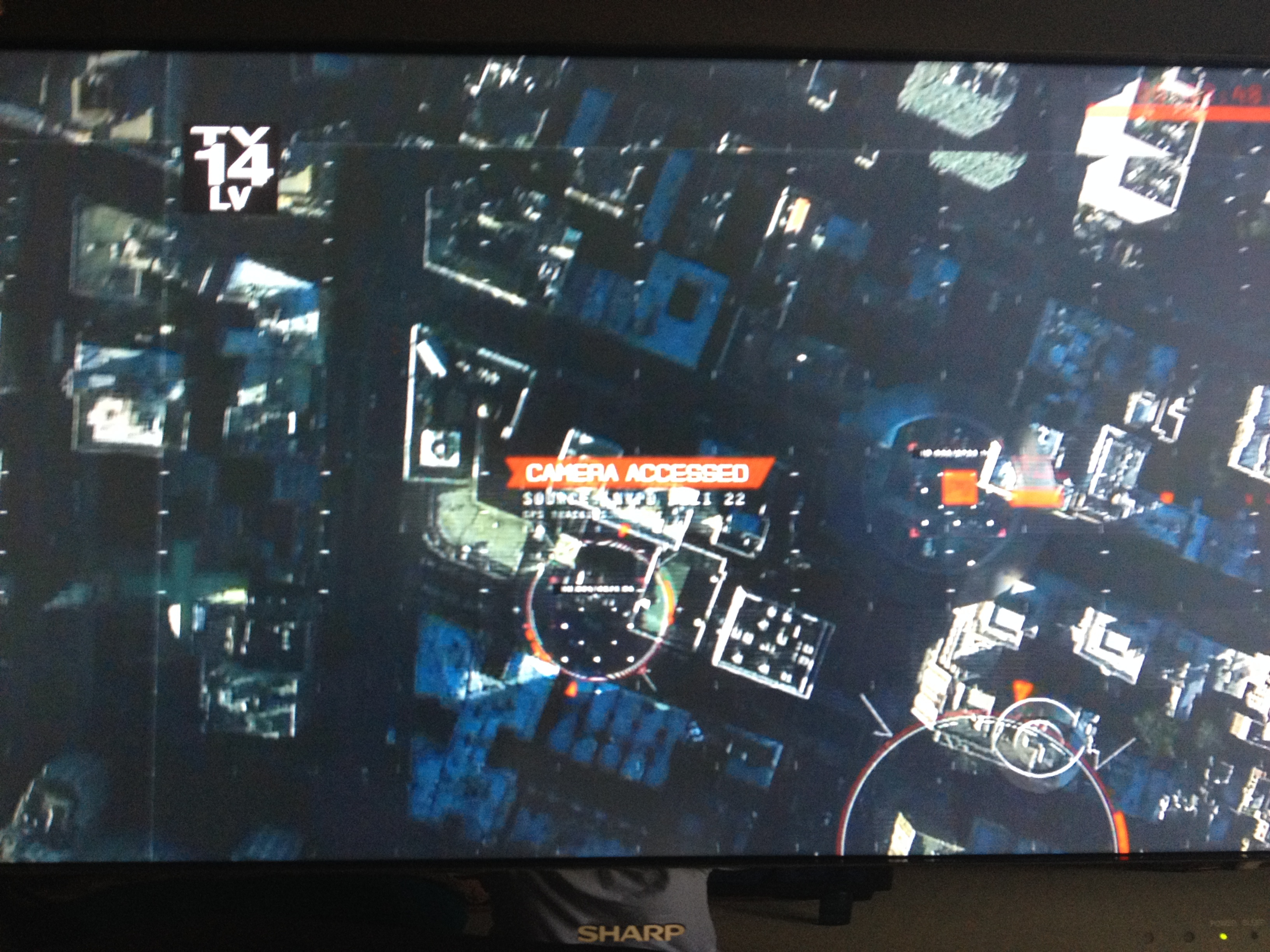
The Machine accesses a camera.
The Machine taps into everything to gather information including a camera on this NYPD helipad.
This slideshow requires JavaScript.
This slideshow shows the records The Machine will analyze when it tracks someone. In this case the lucky subject is Fusco.
This slideshow requires JavaScript.
These shots show The Machine classifying subjects. Reese, of course, is not missing just like Shaw is not dead. These shots were from the season premiere when The Machine may have believed she was but it still identifies her that way five episodes in.
The Machine detects Reese’s camera.
The Machine doesn’t just find a camera, it identifies it. In this case it accessed the wifi in Reese’s camera to determine what it was shooting and details about the camera itself.
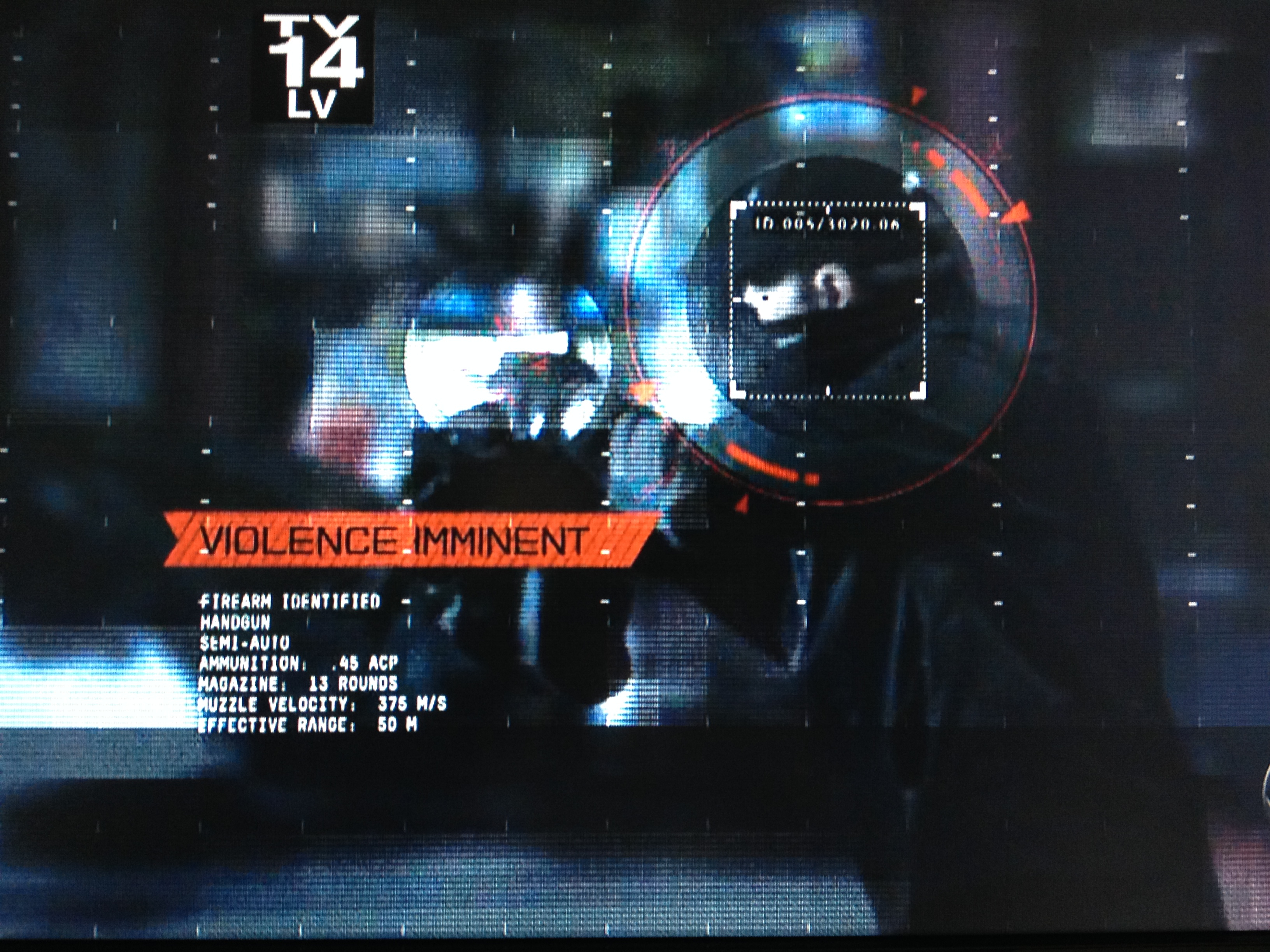
The Machine gathers all kinds of information on a potential threat.
Being able to access so much information in its databases allows The Machine to identify the type of gun this threat is holding (it is hard to see the red triangles around the weapon). Like Reese’s camera, The Machine reads all kinds of information about the gun.
Gathering Information
This slideshow shows four ways The Machine gathers its information and uses it to connect dots between subjects.
This slideshow requires JavaScript.
Tracking Root
Episode three was Root-centric and gave us the best look into The Machine we’ve ever had. First it showed how it identified her and connected her to her different aliases. The Machine then went into its archives to show her walk with Finch last year when he neutralized her threat, albeit temporarily.
This slideshow requires JavaScript.
This sequence is interesting. It shows Root answering the yellow phone at the end of last season from The Machine’s perspective. Notice how her box goes from yellow to yellow and black. According to the wiki: Possibly indicates individuals who not only know about the Machine, but have the ability to communicate with it. The Machine internally designates these individuals as “Analog Interface.” The third photo shows it in her meeting with Dr. Carmichael.
This slideshow requires JavaScript.
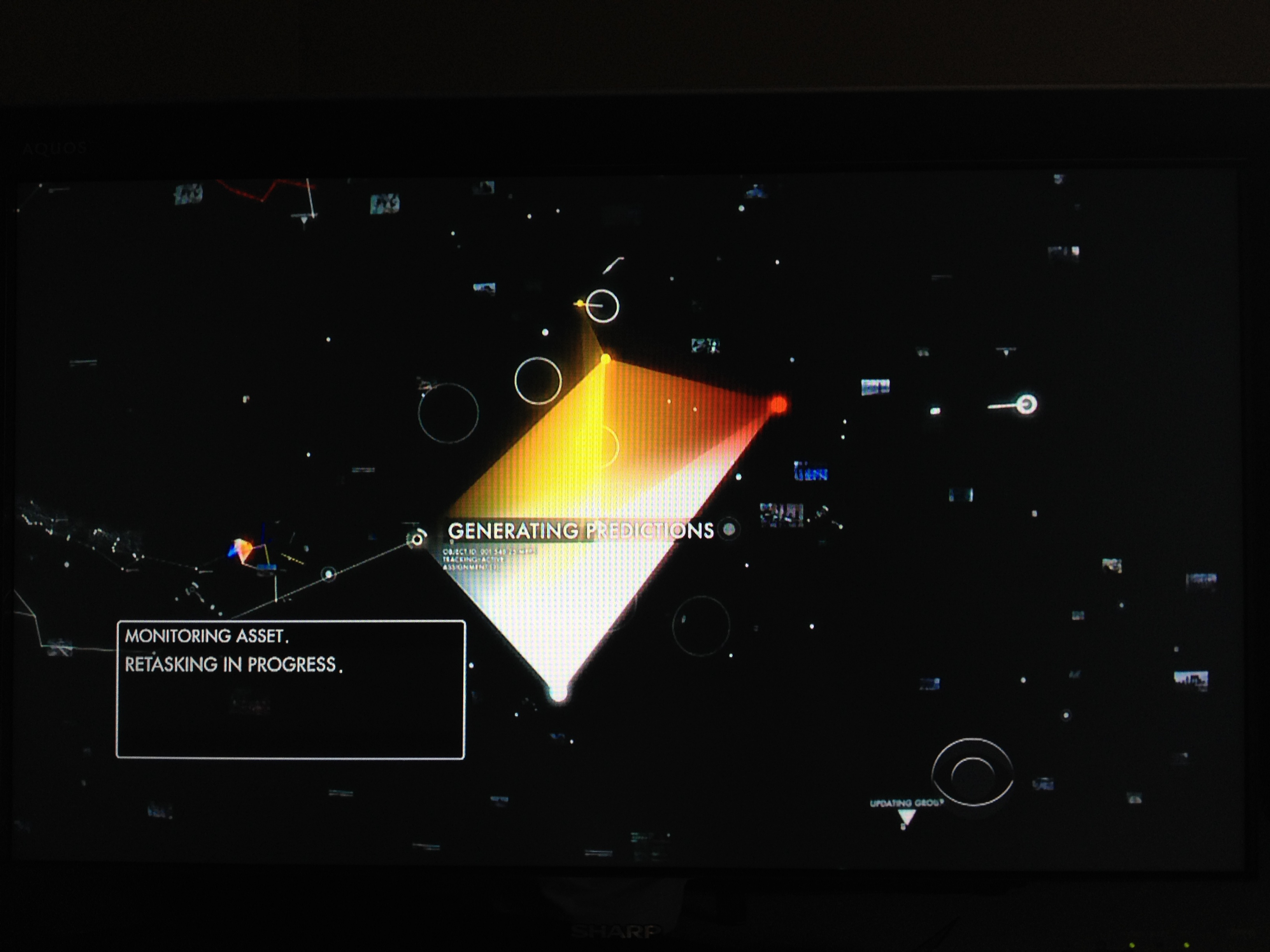
The Machine begins to generate predictions.
This is the shot that prompted me to do this post. I don’t recall the show ever giving us a look at exactly how The Machine goes about determining potential outcomes and their probabilities. It is The Machine on all cylinders, tapping into all of its databases and its vast amount of predictive ability.
The first calculations surrounding Root.
These are the initial predictions. Violence at 30.19 percent, asset activation at 28.44. I’m not sure which asset it means, I assume Root?
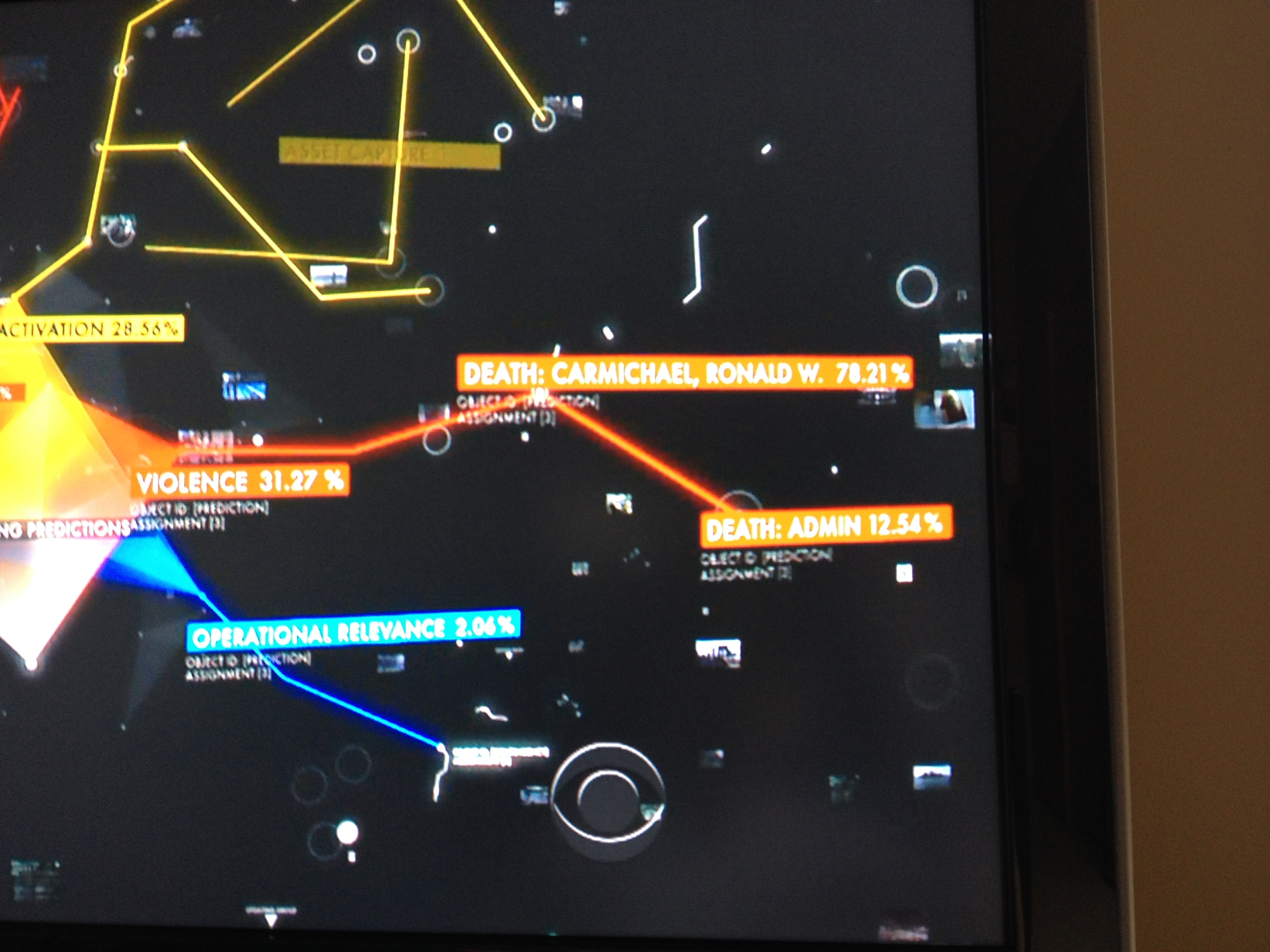
More possibilities come from The Machine’s predictions.
The predictions begin to branch out. Notice how they maintain the color coding system. Red for violence, yellow for assets. Blue is labeled “OPERATIONAL RELEVANCE.” Blue boxes are for government agents pursuing numbers, so this could mean The Machine predicts an outcome where Root will cross paths with someone pursuing The Machine’s true purpose. Note that the percentages have changed. Violence is now more likely, Dr. Carmichael is in serious danger, an administrator may die and asset activation has edged up slightly.
The Machine continues developing predictions.
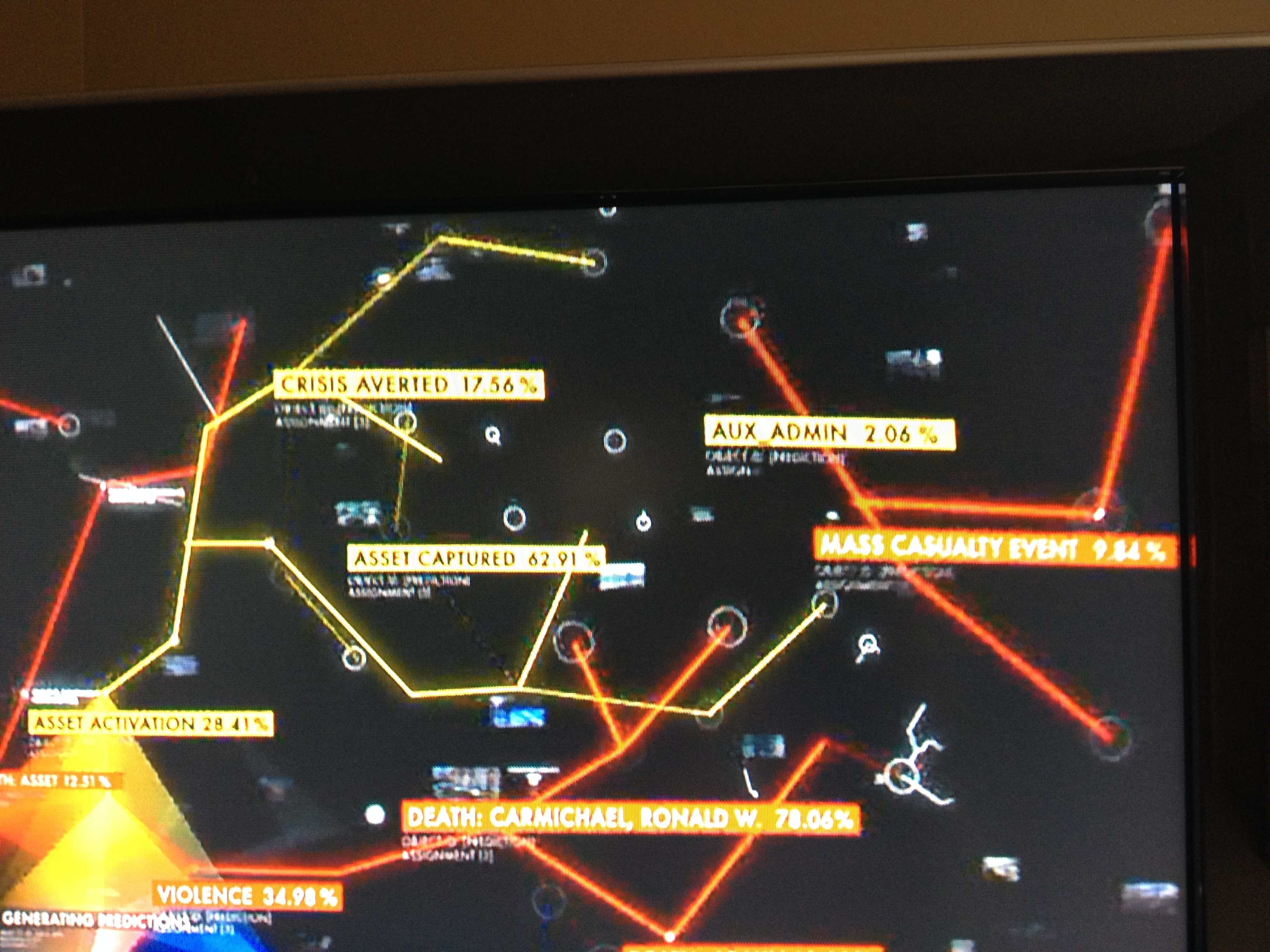
The predictions really begin to sprout. Dr. Carmichael is marginally more likely to survive and a mass casualty event is now predicted at 9.54 percent. Look at all the yellow predictions. Almost 63 percent odds that the asset gets captured, 17.56 percent the crisis is averted and 2 percent for something called Aux Admin. Notice, too, the probability of violence eeks upward.
The Machine sees Valentine’s Day.
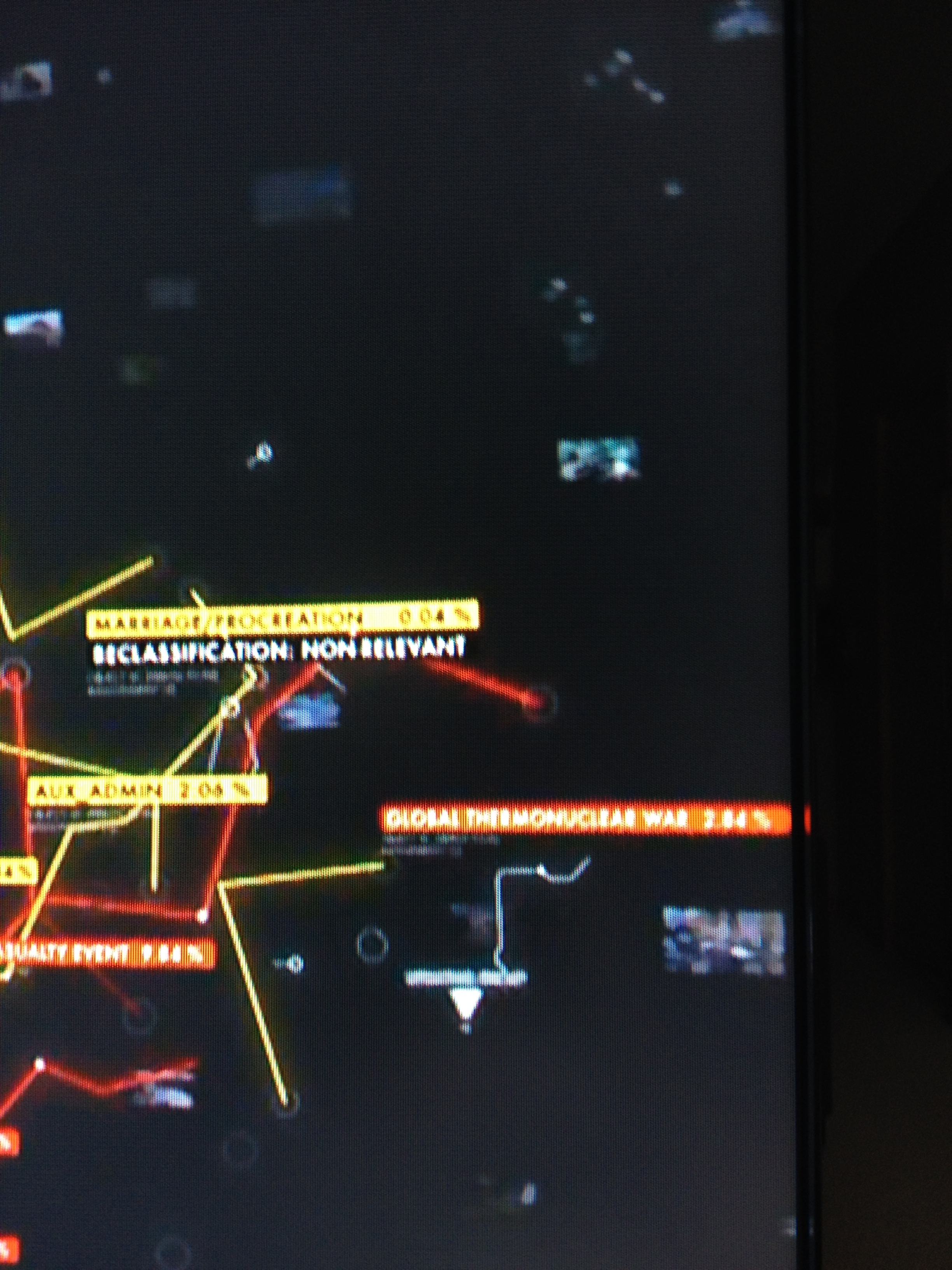
While The Machine predicts a small chance Root will trigger global thermonuclear war look up in the left corner. The Machine covers all possible outcomes, even the 0.04-percent chance that Root and Dr. Carmichael will get married and have kids. Aww! ❤
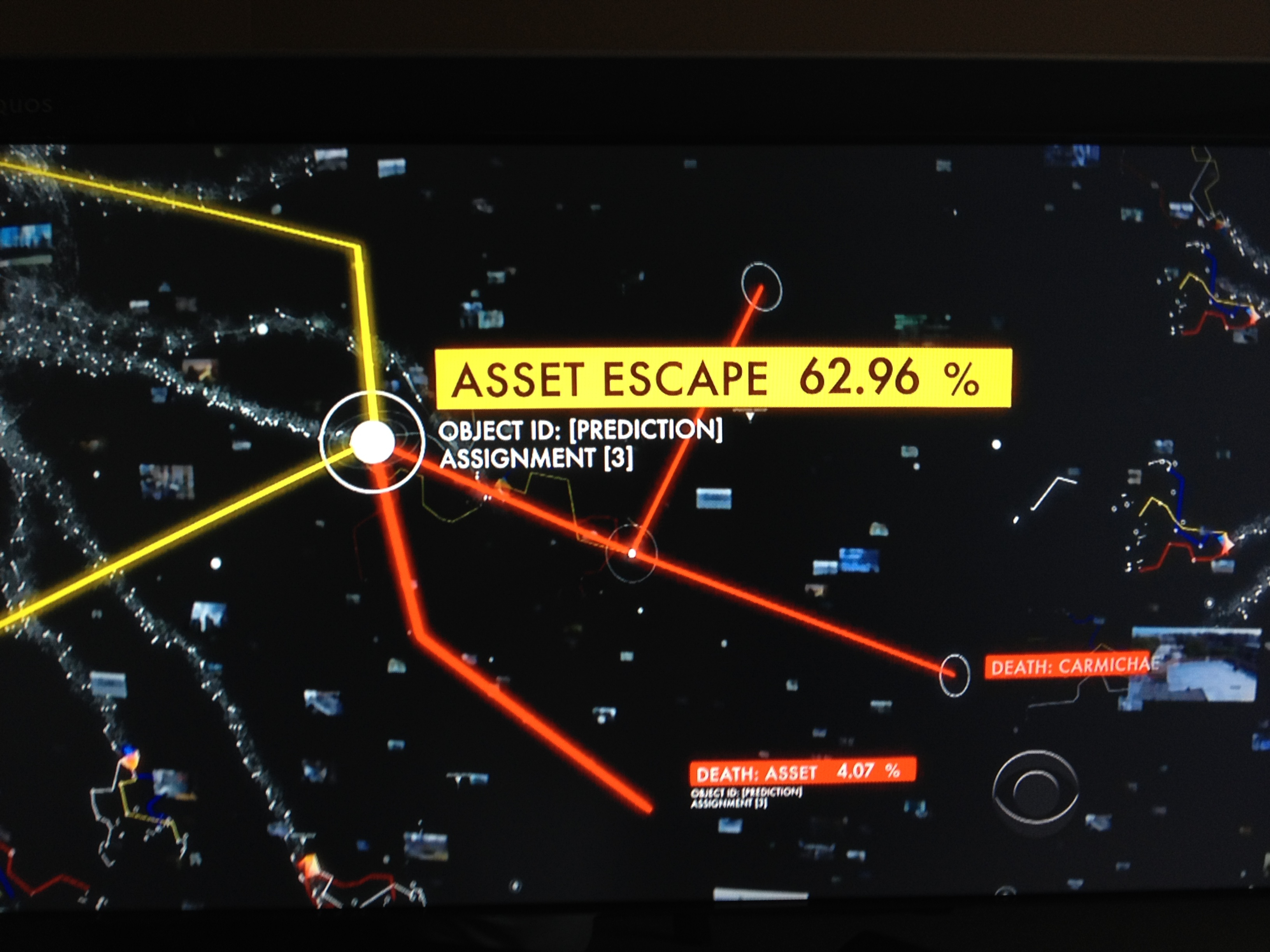
The Machine assesses the likelihood that Root escapes.
The Machine sees a good chance that Root will successfully escape the hospital and a small chance she will die. It’s not pictured but Dr. Carmichael’s percentage changed to 19.9. Things are looking up for the doctor! In the final scene before her escape Root tells him she won’t kill him. The Machine is giving her instructions not to kill people, including Hersh.
The Machine believes it is likely Root will be intercepted.
A new and very likely outcome is predicted: Asset interception.
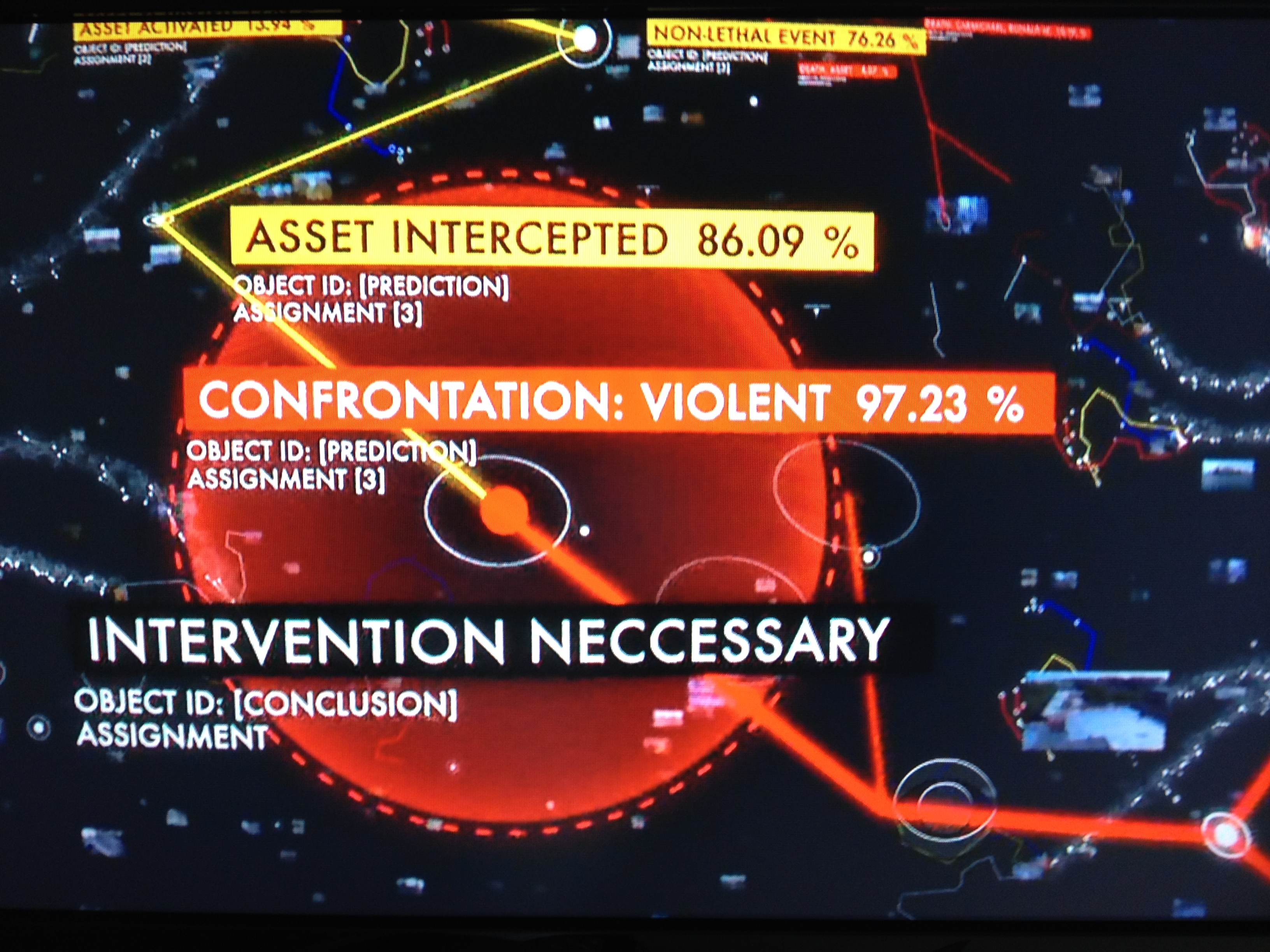
The Machine reaches a conclusion.
This is big. The Machine predicted a 97.23 percent chance of violence and determined an intervention is necessary. It then found Harold near a pay phone and alerted him. Look at all the lines connecting to various bits of information The Machine relied on for its predictions!
Look at this slideshow as The Machine continues to analyze data and make predictions. The data connects different subjects and even identifies the possible death of a subject who’s name is redacted. Hmmm.
This slideshow requires JavaScript.
Target Proximity
Having determined Root is in danger, The Machine plots her location on a map with Hersh’s as we see Hersh leaving a hospital after failing to find Root. The Machine identifies other places he might look before finding the quickest route between his location and Root’s. Another great example of all the information The Machine can pull, process and interpret.
This slideshow requires JavaScript.
Archives
The Machine has gone back in time throughout the series to show us things that happened before the show began. This slideshow tracks The Machine as it scrolls through its timeline to tell Shaw’s story. Again going back to the wiki, when The Machine sees this old footage it analyzes it for the first time, but I’m more interested in where the information comes from. Harold began to train The Machine in 2001, it didn’t go online until 2003. Is it accessing some vast archive? Could it be linked to previous attempts at mass electronic surveillance and data gathering? We don’t know.
This slideshow requires JavaScript.
Thank you for making it to the end of this marathon post. I appreciate it. I really enjoy these little details they drop into TV shows. Lost did it all the time. It gives fans something to examine that yields a better understanding of the show and shows the producers take the most minute details seriously.
This post took the better part of a Saturday to put together. I reviewed all five episodes this season and went slow-motion through every image we saw through The Machine’s eyes, pausing to scour the screen and take photos. They are iPhone photos and it wasn’t always easy to pause the show at exactly the right moment for the text to be sharp.
I’ll have a future post about what’s going on with Root and the unique relationship she has with The Machine.
Samantha Shaw (Sarah Shahi) on Person of Interest Photo: CBS.com
The final episodes of Person of Interest’s second season were fantastic, but as I look back on them they feel more like a series finale. The start of season three reinforces the feeling. The two-man team of Harold Finch and John Reese is now a team of five. We knew it would expand to three with the addition of Samanatha Shaw, but I did not see Fusco and Carter coming so fully under Harold’s umbrella. The plots The Machine involves them in are more complicated now and require the extra people. This is great for the show. The Harold and Reese duo was beginning to grow stale. I think it is better to shake that up now before it turns into a drag the show can’t recover from.
Shaw’s snarky and no-nonsense style plays well against Finch, and Reese appreciates her style for the way it knocks Harold off his guard. The most recent episode gave us the background we need to appreciate her character and her…odd…range of emotions. The writers did a great job of showing how her personality was present at a young age and contrasting her childhood and adulthood with a young girl from Russia who fancied herself a spy. The end of the episode took care to show us that Shaw has emotions, they’re just muted. Now we can wait to learn more about how she became involved with Hesch and Northern Lights.
Detective Fusco got his new lease on life late last season and is now a normal enough detective that he has the freedom to answer Finch’s every call. Joss Carter on the other hand was demoted for snooping too close for HR’s comfort after it took out her boyfriend and fellow detective Carl Beecher. The HR storylines have never been my favorite part of the show. I hoped after both seasons it would recede from the show, and it appears that hope will again go unfulfilled this season. Officer Carter’s partner is, you guessed it, in HR’s pocket, but she was onto him and forced him to work for her in a great scene at the end of this week’s episode. HR wants to find Mr. Reese and I have to say I have no desire to see this storyline.
The most mysterious character in Person of Interest has always been The Machine. Last season climaxed with it rebooting and self-relocating out of its original hiding place inside a nuclear facility. How it came back and how it changed was set to be a major part of the season, but it has been almost nonexistent.
When it does play out, it comes via Root. She got the final scene last season to answer a call at a yellow pay phone a psychiatric hospital. The “new” Machine took it upon itself to help her break out by speaking to her in the same “God mode” it did while ,it rebooted. Amy Acker’s perfection for the role of Root shined in her counseling sessions with the hospital’s psychiatrist. After telling him for weeks that “God” was talking to her, she predicted to him exactly what was about to happen before she escaped during their final session. His reaction was fantastic and Acker played up every bit of the patient curing the doctor.
How The Machine interacts with her could provide clues to its new personality. We have no reason to think Finch created or knows of a way for it to access its own God mode to interact with anyone. In fact he seemed bewildered when he arrived at the hospital after Root’s escape. Is this a new ability it created for itself? A side effect of the virus-within-a-virus Harold created that infected it last season? We will find out.
We will also find out who the mysterious Ma’am was that Hesch visited at the end of last season. He and Ma’am view her as enough of a threat to warrant his attempt to eliminate her in the hospital; Harold obviously feels the same because he locked her away in an institution. Maybe those two will team up this season to ensure she isn’t able to achieve her goal of freeing The Machine?
I have one bone to pick with some of the early storylines. Not long after last season ended, the Edward Snowden story launched government surveillance to the top of the world’s radar. Every time a new revelation came out about the government tracking phone calls, reading emails or hacking bank accounts I couldn’t help but think, “That’s The Machine!” It was kind of spooky.
The Machine’s mystique — fed by its secrecy — is integral to the show’s make up, not just within the show but in viewers’ minds. The thought that government could be capable of the electronic dragnet Finch uses helps us believe in the story. It is too fantastic to be real, therefore it must be entertainment. To find out it exists in real life is as if Harold would turn to the camera in the middle of an episode to confess that he is a real life NSA employee.
How the show deals with this, if it does at all, could elevate the show even higher or sink it. That’s why I would prefer they ignore it entirely and go on with the story exactly as they imagined it before anyone heard of Edward Snoden. Maybe that is what they are doing, but too many of this season’s episodes have devolved into a lecture about online privacy.
I think we are one or two episodes shy of seeing everything we need to know about what this season will contain. For the most part, it’s on the right track to maintain its position as the most enjoyable show I watch.
“Some believe confession helps a guilty soul find peace, releasing us from the shame and regret of our mistakes. In the face of mortality, many feel the need to seek this closure to make things right. Because if death doesn’t kill us, our demons will.”
That is the Emily Thorne voiceover to begin last Sunday’s episode, Confession. Here is the one that closed it:
“A guilty heart is silent, it’s pulse muffled by the secrets it keeps. While some believe confession can release a tortured soul, others view it as a sign of weakness. Because ultimately whatever you say, however you feel about what you’ve done, it’s irrelevant for the hand of death is equally unforgiving.”
In between Revenge stuck to the religious theme it established last week as Emily manipulated Conrad toward a confession. I love this and think it’s great for the show. Creator Mike Kelley described the show as a modern day telling of The Count of Monte Cristo and chose to open it with a quote from Confucius. But those themes were rarely referred to and I would say forgotten by the end of his time as producer. Adding a religious base reminds me of the way Lost’s writers made heavy references to religion, literature and philosophy. All three provide universal themes from which you can tell any story and give it much more depth.
Revenge could have spent several episodes developing a plot line that led to Conrad’s decision. Instead it mixed themes of confession and forgiveness to do it in two. In scenes with Emily and Father Paul, Conrad is very much a man representing the Bible verse I cited in last week’s piece. He believes confession will wash away his sins and tells Father Paul, “I welcome death now.” Conrad’s decision is sealed by believing a confession will give Charlotte back the father he took from her in sin. Through confession and forgiveness, redemption.
This is such an improvement over last season that I am almost ready to declare Revenge to be “back.”
But of course while Conrad attempts to find God, Emily continues to defy it. Instead of seeking forgiveness and redemption for framing Father Paul, she doubles down on her alleged regret and blackmails him into working on Conrad. Convince him to confess or be exposed again, she tells him.
He succeeds, but their journey to confession ends in a fiery crash. Father Paul is dead. Conrad, though weakened from Emily manipulating his drug regimen, survives. What happened? We don’t see. I believe Victoria Grayson happened.
Scroll back up to the final voice-over. “A guilty heart is silent, it’s pulse muffled by the secrets it keeps.” That is Victoria, a heart turned so wicked by guilt that she hurts her own children without flinching. “While some believe confession can release a tortured soul, others view it as a sign of weakness.” This line is meant to symbolize the perspectives Conrad and Victoria hold at this point in the story. Remember what she told Patrick last week when she sold her painting: “The world I live in, if they sense this vulnerability they will use it as a weapon. So, I part with the things I love.” She believes facing mortality made Conrad too weak, and therefore vulnerable to what she would perceive as religious foolishness. Enough so that she would “part” with Conrad? Consider her rationalization to Patrick: Some sacrifices are easier than others.
The final line in Emily’s voiceover should convince us that the crash was not a case of reckless driving. “Because ultimately whatever you say, however you feel about what you’ve done, it’s irrelevant for the hand of death is equally unforgiving.” Sorry, Father Paul, you do not get to confess, there will be no cleansing for your soul. The hand of death got you first.
Now Emily’s twisted sense of redemption has led a reformed man to his grave. She continued her moral downward spiral by laying a new layer of lies on her relationship with Daniel and leveling Victoria with a humiliating public revelation of the Grayson’s financial troubles.
Emily Thorne’s descent resembles Walter White’s in Breaking Bad. We began the show rooting for her to get revenge on the evil Graysons, but now she has turned into the people she came to the Hamptons to destroy. Her takedown of Father Paul is meant to represent what happened to her own father and show that she has, for all intents and purposes, become a Grayson. She lies to the people she loves. She plots with no regard or remorse. I can’t root for her to win any more than I could root for Walter. She is sealing her fate in one of the graves Confucius warns about. Maybe not representing physical death but a life with no one to turn to. The life Conrad tells her of when he admits he has no relationships to fall back on in his dying days. Father Paul told Conrad no one wants to die alone. That is exactly where Emily is headed and right now it is exactly what she deserves.
If death doesn’t kill her, her demons surely will. Two graves, equally unforgiving.






 The Wandering Lostie